Albert Camus

Birth Name:
Albert Camus
Birth Date:
November 7, 1913
Birth Place:
Mondovi, French Algeria
Death Date:
January 4, 1960
Place of Death:
Route Nationale 5, Villeblevin, France
Age:
46
Cause of Death:
Automobile accident
Cemetery Name:
Cimetière de Lourmarin
Claim to Fame:
Writers and Poets
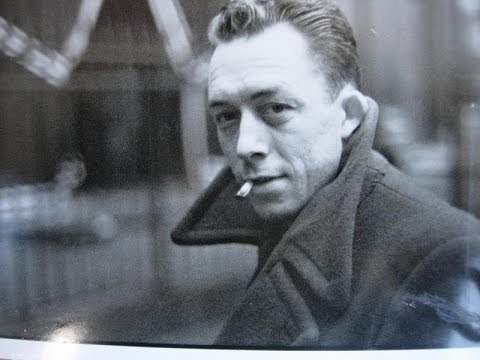
Albert Camus was a French philosopher, author, dramatist, journalist, and political activist. He was the recipient of the 1957 Nobel Prize in Literature at the age of 44, the second-youngest recipient in history. Some of his best known works include The Stranger, The Plague, The Myth of Sisyphus, The Fall, and The Rebel.The dominant philosophical contribution of Camus’s work is absurdism. While he is often associated with existentialism, he rejected the label, expressing surprise that he would be viewed as a philosophical ally of Sartre. Elements of absurdism and existentialism are present in Camus’s most celebrated writing especially in The Myth of Sisyphus (1942). The protagonists of The Stranger and The Plague must also confront the absurdity of social and cultural orthodoxies, with dire results. Camus died on January 4, 1960 at the age of 46, in a car accident near Sens, in Le Grand Fossard in the small town of Villeblevin. He had spent the New Year's holiday of 1960 at his house in Lourmarin, Vaucluse with his family, and his publisher Michel Gallimard, along with Gallimard's wife, Janine, and daughter. Camus's wife and children went back to Paris by train but Camus decided to return in Gallimard's luxurious Facel Vega FV2. The car crashed into a plane tree on a long straight stretch of the Route nationale 5. Camus, who was in the passenger seat, died instantly. Gallimard died a few days later, although his wife and daughter were unharmed.

Fun Facts

Camus, considered a handsome man at the time, was a bit of a womaniser. He married and divorced twice as a young man, stating his disapproval of the institution of marriage throughout, and had many extramarital affairs. When he was just 20 he met a beautiful drug addict named Simone Hié. She was addicted to morphine, and despite his family’s disapproval Camus married her to help her fight her addiction. He later discovered she was “cuddling” with her doctor at the same time and the couple divorced shortly after.

French President Nicolas Sarkozy suggested that his remains be moved to the Panthéon, an idea that was criticised by Camus’s surviving family and went no further.

Cemetery Information:

Final Resting Place:

Cimetière de Lourmarin

Avenue Henri Bosco

Lourmarin, , 84160

France

Europe

Map:
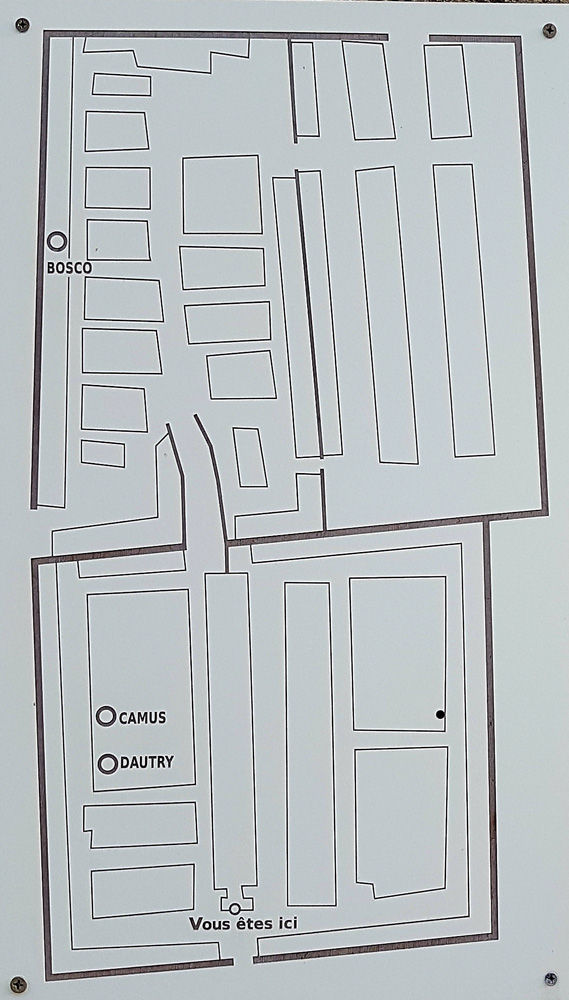
Map of Cimetière de Lourmarin in Lourmarin, France
Cimetière de Lourmarin in Lourmarin, France

Grave Location:

Camus Family Plot

Grave Location Description

As you enter the cemetery make an immediate left turn and walk to the end of the path then turn right. Walk about 50 feet and the simple stone memorial for philosopher and author Albert Camus is on the right.

Grave Location GPS

43.759703702613244, 5.362006968867101

Visiting The Grave:

Photos:

[+]
[+]
[+]
[+]
[+]
[+]
[+]
[+]
[+]
[+]
[+]
[+]
[+]
[+]
[+]
[+]
[+]
[+]

FAQ's

Albert Camus was born on November 7, 1913.

Albert Camus was born in Mondovi, French Algeria.

Albert Camus died on January 4, 1960.

Albert Camus died in Route Nationale 5, Villeblevin, France.

Albert Camus was 46.

The cause of death was Automobile accident.

Albert Camus's grave is in Cimetière de Lourmarin

Read More About Albert Camus:

Videos Featuring Albert Camus:

See More:

Jules Verne

popular name: Jules Verne

date_of_death: March 24, 1905

age: 77

cause_of_death: Chronic diabetes and complications from a stroke

claim_to_fame: Writers and Poets

best_know_for: Jules Verne was a French novelist, poet and playwright best known for his adventure novels and is often regarded as one of the pioneers of science fiction. Born in Nantes, France, Verne initially studied law but eventually turned to writing. He was heavily inspired by the technological advancements of his time and often incorporated them into his stories. Verne's most famous works include Twenty Thousand Leagues Under the Sea, Journey to the Center of the Earth, Around the World in Eighty Days, and The Mysterious Island. These novels blended adventure with futuristic scientific concepts and often predicted inventions like submarines and space travel. Despite some initial financial struggles, Verne gained fame and success after his works began to be published in serialized form. His imaginative stories captured the public's imagination, and he became one of the most translated authors of his time. Verne's later life was marked by personal tragedy, including a serious injury that left him partly disabled nonetheless he continued writing until his death in 1905.

Sir Arthur Conan Doyle

popular name: Sir Arthur Conan Doyle

date_of_death: July 7, 1930

age: 71

cause_of_death: Heart attack

claim_to_fame: Writers and Poets

best_know_for: Over 125 years after his creation, Sherlock Holmes remains the most popular fictional detective in history. Arthur Conan Doyle is best known for the 60 stories he wrote about Sherlock Holmes. His body of work includes nearly 200 novels, short stories, poems, historical books and pamphlets.

Sylvia Beach

popular name: Sylvia Beach

date_of_death: October 5, 1962

age: 75

cause_of_death: Natural causes

claim_to_fame: Writers and Poets

best_know_for: In the 1920s and 1930s, Sylvia Beach owned and ran Shakespeare and Company, a Paris bookshop. The shop became the community center for "lost generation" intellectuals from Britain and America, including James Joyce, Ezra Pound, Ernest Hemingway, John Dos Passos, Stephen Spender, Djuna Barnes, Kay Boyle, Natalie Barney, Mina Loy, Margaret Anderson , and Gertrude Stein , as well as for prominent French writers like Paul Valéry, André Gide, and Paul Claudel. In 1959, Beach published her memoirs, Shakespeare and Company, a lively conversational account of the shop during the interwar years. She had a large collection of James Joyce's first editions, manuscripts and memorabilia, and as Joyce's reputation continued to grow—though he had died in 1940—Beach was approached by dozens of Joyce scholars for access to her collection.

Back to Top