Arnold Schoenberg

AKA:
Arnold Schönberg
Birth Name:
Arnold Schoenberg
Birth Date:
September 13, 1874
Birth Place:
Obere Donaustraße 5, Leopoldstadt, Vienna, Austria
Death Date:
July 13, 1951
Place of Death:
116 N Rockingham Avenue, Los Angeles, California
Age:
76
Cause of Death:
Myocardial infarction
Cemetery Name:
Der Wiener Zentralfriedhof
Claim to Fame:
Music
Arnold Schoenberg was an Austrian-American composer, music theorist, teacher, writer, and painter. He is widely considered one of the most influential composers of the 20th century. He was associated with the expressionist movement in German poetry and art, and leader of the Second Viennese School. Schoenberg's approach, both in terms of harmony and development, has shaped much of 20th-century musical thought. Many composers from at least three generations have consciously extended his thinking, whereas others have passionately reacted against it. Schoenberg was known early in his career for simultaneously extending the traditionally opposed German Romantic styles of Brahms and Wagner. Later, his name would come to personify innovations in atonality (although Schoenberg himself detested that term) that would become the most polemical feature of 20th-century classical music. In the 1920s, Schoenberg developed the twelve-tone technique, an influential compositional method of manipulating an ordered series of all twelve notes in the chromatic scale. He also coined the term developing variation and was the first modern composer to embrace ways of developing motifs without resorting to the dominance of a centralized melodic idea. Schoenberg's archival legacy is held at the Arnold Schönberg Center in Vienna.

Interesting to Know

Schoenberg was also an influential teacher of composition; his students included Alban Berg, Anton Webern, Hanns Eisler, Egon Wellesz, Nikos Skalkottas and later John Cage, Lou Harrison, Earl Kim, Robert Gerhard, Leon Kirchner, Dika Newlin, Oscar Levant, and other prominent musicians. Many of Schoenberg’s practices, including the formalization of compositional method and his habit of openly inviting audiences to think analytically, are echoed in avant-garde musical thought throughout the 20th century.

The composer’s final days are documented in handwritten notes by his wife Gertrud, who meticulously recorded the progression of his illness and the daily routines, along with house visits by his physician Dr Orren Lloyd-Jones. On July 13, 1951 Schönberg did not eat at all and he received a sedative a few hours before his death. At 6 p.m. his pulse was 90, at 7:30 p.m. it was 72. At 11:45 p.m. Arnold Schönberg died with his wife beside him. His final word was “harmony.” On July 14 Anna Mahler took an impression of his face for the death mask.

Over the years since his passing, there has been made much about his anxiety due to triskaidekaphobia (fear of the number 13). Interesting to note that he died on Friday the 13th at the age of 76 (7+6=13).

Cemetery Information:

Final Resting Place:

Der Wiener Zentralfriedhof

1110 Wien

Simmeringer Hauptstraße 234, Vienna,

Austria

Europe

Map:
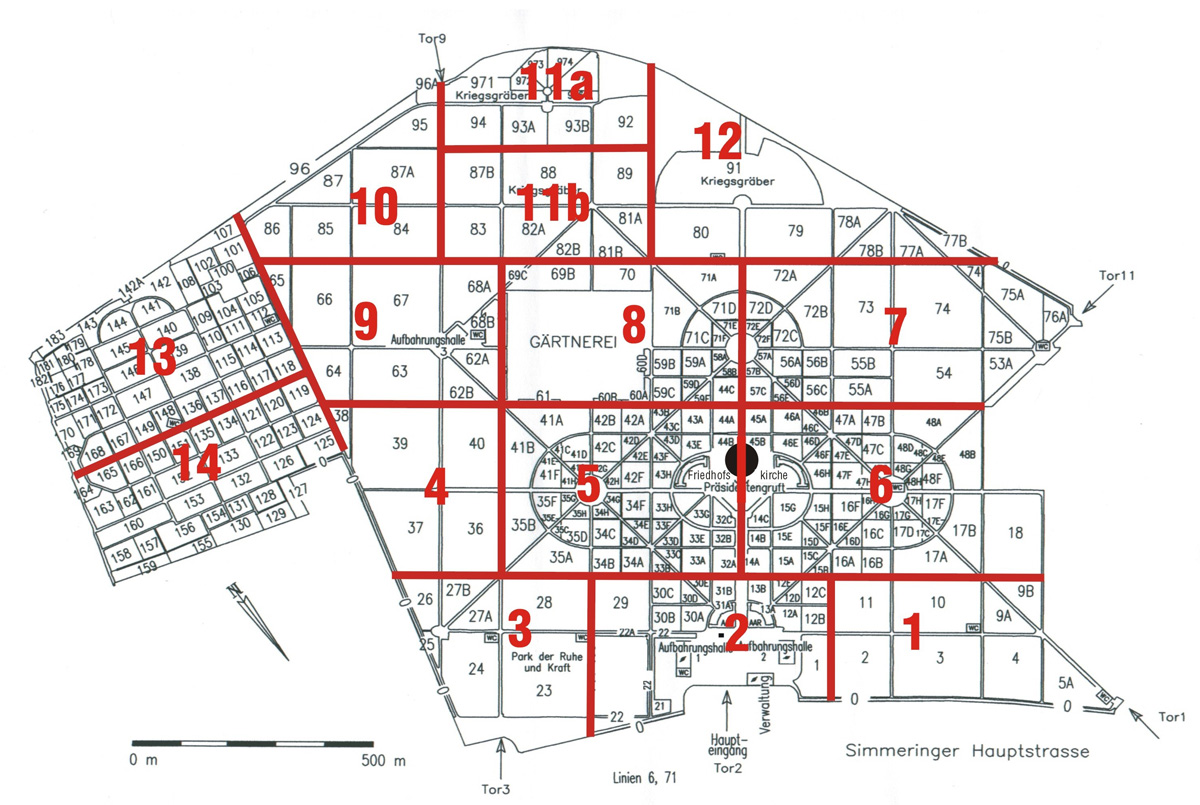
Map of Der Wiener Zentralfriedhof in Vienna Austria
Der Wiener Zentralfriedhof in Vienna Austria

Grave Location:

Gruppa 32 C, Grab Nr. 21A

Grave Location Description

As you enter the cemetery through Tor 2 (Gate 2) drive straight ahead towards The St. Charles Borromeo Cemetery Church in the middle of the Vienna Central Cemetery. As you approach the church take the last soft left turn and look to your left into Gruppa 32 C and you will find the large angled cube that marks the grave of Arnold Schoenberg.

Grave Location GPS

48.15135047185499, 16.43914433457052

Photos:

[+]
[+]
[+]
[+]
[+]
[+]
[+]
[+]
[+]
[+]
[+]
[+]
[+]
[+]
[+]

FAQ's

Arnold Schoenberg was born on September 13, 1874 .

Arnold Schoenberg was born in Obere Donaustraße 5, Leopoldstadt, Vienna, Austria.

Arnold Schoenberg died on July 13, 1951.

Arnold Schoenberg died in 116 N Rockingham Avenue, Los Angeles, California.

Arnold Schoenberg was 76.

The cause of death was Myocardial infarction.

Arnold Schoenberg's grave is in Der Wiener Zentralfriedhof

Read More About Arnold Schoenberg:

Videos Featuring Arnold Schoenberg:

See More:

Dinah Washington

popular name: Dinah Washington

date_of_death: December 14, 1963

age: 39

cause_of_death: Accidental overdose - prescription diet and sleep medication mixed with alcohol

claim_to_fame: Music

best_know_for: Dinah Washington was an American singer and pianist who has been cited as "the most popular black female recording artist of the 1950s". Primarily a jazz vocalist, she performed and recorded in a wide variety of styles including blues, R&B, and traditional pop music and gave herself the title of "Queen of the Blues". It all started when she won a talent show at the age of 15. Shortly after she teamed up with Lionel Hampton and stayed with his orchestra until 1946. Going solo she released a diverse catalog of hits for the mainstream black population including Hank William's "Cold, Cold Heart," the Orioles "It's Too Soon To Know" and her biggest hit of the 1940s "Baby, Get Lost". Washington continued her chart success maintaining a spot on the Top 10 R&B charts from 1949 through 1955 with "I've Got You Under My Skin" and "What A Difference A Day Makes". In July 1963, football great Dick "Night Train" Lane married jazz singer Dinah Washington at a ceremony in Las Vegas. It was the sixth marriage for Washington and the second for Lane. Just five months later early in the morning of December 14, 1963, Lane went to sleep with Washington who awoke later to find her slumped over and not responsive. She was pronounced her dead at the scene at age 39. An autopsy later showed a lethal combination of secobarbital and amobarbital, prescriptions for her insomnia and diet, which contributed to her death. She was a 1986 inductee of the Alabama Jazz Hall of Fame and was inducted into the Rock and Roll Hall of Fame in 1993. She was laid to rest at Burr Oak Cemetery in Alsip, Illinois.

Fritz Kreisler

popular name: Fritz Kreisler

date_of_death: January 29, 1962

age: 86

cause_of_death: Heart failure

claim_to_fame: Music

best_know_for: Making his professional debut at the age of 13, Fritz Kreisler is considered the one of the greatest, if not the greatest, violinist ever to play the instrument. His technique was animated by a riveting vibrato the likes of which no one had previously possessed or even imagined, and he used it constantly, even in passagework. Kreisler owned several antique violins made by luthiers Antonio Stradivari, Pietro Guarneri, Giuseppe Guarneri, and Carlo Bergonzi. He was the owner of the great Guarneri "del Gesu" violin of 1733 which was donated to the Library of Congress.

Bobby Fuller

popular name: Bobby Fuller

date_of_death: July 18, 1966

age: 23

cause_of_death: Homicide by inhalation of gasoline (disputed)

claim_to_fame: Music

best_know_for: "I fought the law and the law won". These words became an anthem for a generation of disaffected youth during the turbulent 60s. Written and sung by Bobby Fuller fronting the Bobby Fuller Four, like so many young talent of those unsettling times was destined to die a tragic death. A death that is a source of controversy and speculation today.

Back to Top