Johann Strauss ll

AKA:
The Waltz King
Birth Name:
Johann Baptist Strauss II
Birth Date:
October 25, 1825
Birth Place:
Vienna, Austria
Death Date:
June 3, 1899
Place of Death:
Johann Strauss Gasse 4, Wieden, Vienna, Austria
Age:
73
Cause of Death:
Pleuropneumonia
Cemetery Name:
Der Wiener Zentralfriedhof
Claim to Fame:
Music
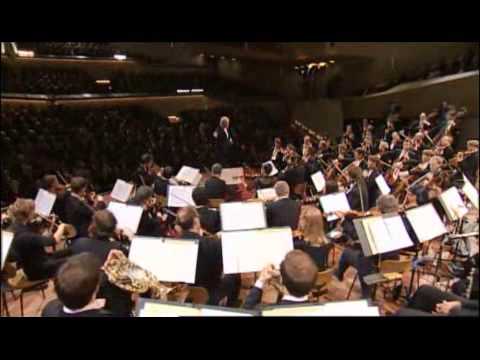
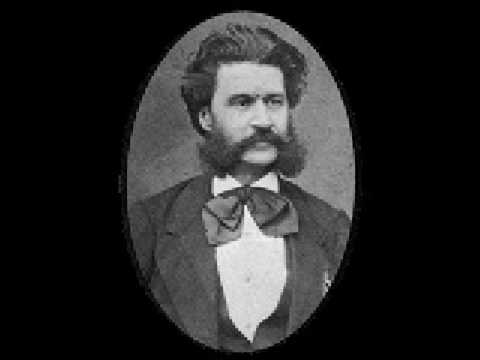
Johann Strauss II (also referred to as Johann Strauss Jr., the Younger) was an Austrian composer of light music, particularly dance music and operettas as well as a renown violinist. He composed over 500 waltzes, polkas, quadrilles, and other types of dance music, as well as several operettas and a ballet. In his lifetime, Strauss ll was known as "The Waltz King", and was largely responsible for the popularity of the waltz in Vienna during the 19th century. Some of Johann Strauss's most famous works include "The Blue Danube", "Kaiser-Walzer" (Emperor Waltz), "Tales from the Vienna Woods", "Frühlingsstimmen", and the "Tritsch-Tratsch-Polka". Among his operettas, Die Fledermaus and Der Zigeunerbaron are the best known. Strauss was the son of Johann Strauss I and his first wife Maria Anna Streim. Two younger brothers, Josef and Eduard Strauss, also became composers of light music, although they were never as well known as their brother.

Fun Facts

Most of the Strauss ll works that are performed today may once have existed in a slightly different form, as Eduard Strauss destroyed much of the original Strauss orchestral archives in a furnace factory in Vienna’s Mariahilf district in 1907. Eduard, then the only surviving brother of the three, took this drastic precaution after agreeing to a pact between himself and brother Josef that whoever outlived the other was to destroy their works. The measure was intended to prevent the Strauss family’s works from being claimed by another composer. This may also have been fueled by Strauss’s rivalry with another of Vienna’s popular waltz and march composers, Karl Michael Ziehrer.

Also lost to the ages, Eduard Strauss surprisingly wound up the Strauss Orchestra in February 1901 after concerts in 840 cities around the globe, and pawned the instruments. The orchestra’s last violins were destroyed in the firestorm of the Second World War.

Two museums in Vienna are dedicated to Johann Strauss II. His residence in the Praterstrasse, where he lived in the 1860s, is now part of the Vienna Museum. The Strauss Museum is about the whole family, with a focus on Johann Strauss II.

Cemetery Information:

Final Resting Place:

Der Wiener Zentralfriedhof

1110 Wien

Simmeringer Hauptstraße 234, Vienna,

Austria

Europe

Map:
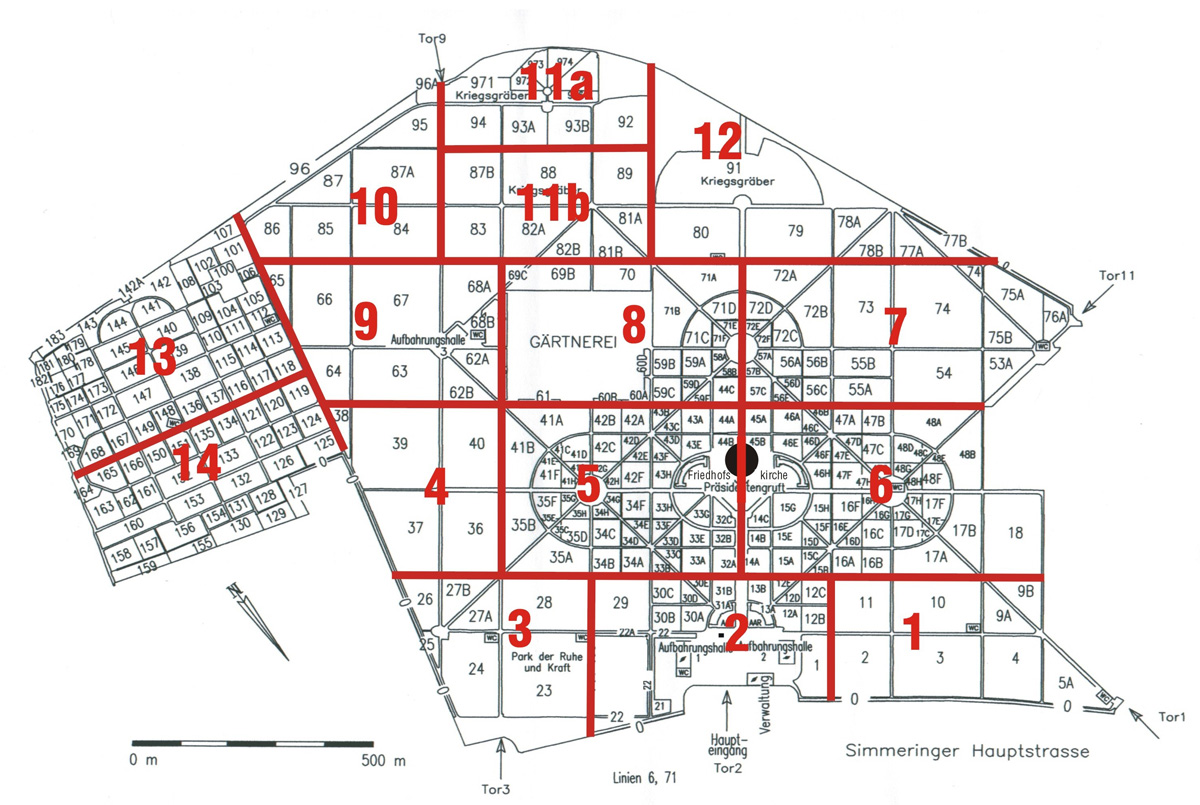
Map of der Wiener Zentralfriedhof in Vienna, Austria
Der Wiener Zentralfriedhof in Vienna, Austria

Grave Location:

Gruppe 32 A, Grab Nr. 27

Grave Location Description

You can find the grave very easily if you enter the cemetery through that main entrance, which is called Tor (Gate) 2. Once inside, go straight on, through the middle of the stone arcade ahead of you, towards the large Jugendstil church in the distance. Just keep your eyes on the left hand side to eventually spot the grave of the legendary composer about 100 feet off the road. Nearby neighbors include Beethoven, Schubert, and Brahms. Across the paved path is a memorial to some guy named Mozart.

Grave Location GPS

48.1519419, 16.4398676

Visiting The Grave:

Photos:

[+]
[+]
[+]
[+]
[+]
[+]
[+]
[+]
[+]
[+]
[+]
[+]

FAQ's

Johann Strauss ll was born on October 25, 1825.

Johann Strauss ll was born in Vienna, Austria.

Johann Strauss ll died on June 3, 1899.

Johann Strauss ll died in Johann Strauss Gasse 4, Wieden, Vienna, Austria.

Johann Strauss ll was 73.

The cause of death was Pleuropneumonia.

Johann Strauss ll's grave is in Der Wiener Zentralfriedhof

Read More About Johann Strauss ll:

Videos Featuring Johann Strauss ll:

See More:

Louis Armstrong

popular name: Louis Armstrong

date_of_death: July 6, 1971

age: 69

cause_of_death: Heart attack

claim_to_fame: Music

best_know_for: From a New Orleans boys’ home to Hollywood, Carnegie Hall, movies and television, the tale of Louis Armstrong’s life and triumphant six-decade career epitomizes the American success story. His trumpet playing revolutionized the world of music, and he became one of our century’s most recognized and best loved entertainers. With his instantly recognizable rich, gravelly voice, Armstrong was also an influential singer and skillful improviser. He was also skilled at scat singing. By the end of Armstrong's life, his influence had spread to popular music in general. Armstrong's best known songs include "What a Wonderful World", "La Vie en Rose", "Hello, Dolly!", "On the Sunny Side of the Street", "Dream a Little Dream of Me", "When You're Smiling" and "When the Saints Go Marching In". He collaborated with Ella Fitzgerald, producing three records together: Ella and Louis (1956), Ella and Louis Again (1957), and Porgy and Bess (1959). He also appeared in films such as A Rhapsody in Black and Blue (1932), Cabin in the Sky (1943), High Society (1956), Paris Blues (1961), A Man Called Adam (1966), and Hello, Dolly! (1969). Armstrong received numerous accolades including the Grammy Award for Best Male Vocal Performance for Hello, Dolly! in 1965, as well as a posthumous win for the Grammy Lifetime Achievement Award in 1972, and induction into the National Rhythm & Blues Hall of Fame in 2017. Upon his death, he was laid to rest at Flushing Cemetery in Queens, New York.

Benny Goodman

popular name: Benny Goodman

date_of_death: June 13, 1986

age: 77

cause_of_death: Heart attack

claim_to_fame: Music

best_know_for: American jazz clarinetist and bandleader known as the "King of Swing". Benny Goodman led one of the first integrated jazz groups and help start the careers of many jazz musicians including Lionel Hampton, trumpeters Ziggy Elman and Harry James, pianists Jess Stacey and Teddy Wilson, and drummer Gene Krupa. Benny Goodman, who brought jazz to Carnegie Hall and enthralled millions with renditions of ''Sweet Georgia Brown'' and ''Stompin' at the Savoy'' was also one of the first musicians to earn over $1 million a year during the height of his popularity.

Bunny Berigan

popular name: Bunny Berigan

date_of_death: June 2, 1942

age: 33

cause_of_death: Cirrhosis of the liver

claim_to_fame: Music

best_know_for: Bunny Berigan was an American jazz trumpeter and bandleader who rose to fame during the swing era of the 1930s and early 40s. Although he composed some jazz instrumentals such as "Chicken and Waffles" and "Blues", Berigan was best known for his virtuoso jazz trumpeting, successfully fuse the nuanced tonal palette of Bix Beiderbecke with the bravura power of Louis Armstrong. A tall handsome dark-haired Irishman, Berigan was a charming, popular and charismatic performer deeply adored by his fans and admired by fellow musicians. The road to fame was long and hard for Berigan. He labored in less than stellar ensembles during his early years, grinding out distracted dance music in hotel orchestras at uninspiring residencies. But starting around 1930 there was growing demand for his gifts from the Dorsey Brothers, the Boswell Sisters, Paul Whiteman, Red Norvo, Artie Shaw, Bing Crosby, the CBS and NBC radio networks and the Columbia, Vocalion, Decca, Victor and Brunswick record companies. More than 600 surviving records, transcriptions and airchecks are evidence of Berigan’s brilliant gift for making a song his own. Playing the trumpet equally well from the bottom to the top of its range, his horn soared above the finest bands of the Swing era, gracing the biggest hits of Glenn Miller, Billie Holiday, Benny Goodman and Tommy Dorsey. His 1937 classic recording "I Can't Get Started" was inducted into the Grammy Hall of Fame in 1975 and he was inducted in the ASCAP Jazz Wall of Fame in 2008.

Back to Top