Arnold Schoenberg

AKA:
Arnold Schönberg
Birth Name:
Arnold Schoenberg
Birth Date:
September 13, 1874
Birth Place:
Obere Donaustraße 5, Leopoldstadt, Vienna, Austria
Death Date:
July 13, 1951
Place of Death:
116 N Rockingham Avenue, Los Angeles, California
Age:
76
Cause of Death:
Myocardial infarction
Cemetery Name:
Der Wiener Zentralfriedhof
Claim to Fame:
Music
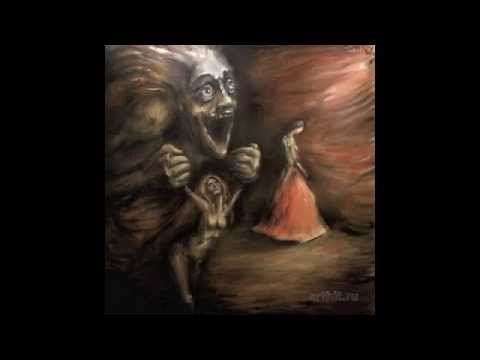
Arnold Schoenberg was an Austrian-American composer, music theorist, teacher, writer, and painter. He is widely considered one of the most influential composers of the 20th century. He was associated with the expressionist movement in German poetry and art, and leader of the Second Viennese School. Schoenberg's approach, both in terms of harmony and development, has shaped much of 20th-century musical thought. Many composers from at least three generations have consciously extended his thinking, whereas others have passionately reacted against it. Schoenberg was known early in his career for simultaneously extending the traditionally opposed German Romantic styles of Brahms and Wagner. Later, his name would come to personify innovations in atonality (although Schoenberg himself detested that term) that would become the most polemical feature of 20th-century classical music. In the 1920s, Schoenberg developed the twelve-tone technique, an influential compositional method of manipulating an ordered series of all twelve notes in the chromatic scale. He also coined the term developing variation and was the first modern composer to embrace ways of developing motifs without resorting to the dominance of a centralized melodic idea. Schoenberg's archival legacy is held at the Arnold Schönberg Center in Vienna.

Interesting to Know

Schoenberg was also an influential teacher of composition; his students included Alban Berg, Anton Webern, Hanns Eisler, Egon Wellesz, Nikos Skalkottas and later John Cage, Lou Harrison, Earl Kim, Robert Gerhard, Leon Kirchner, Dika Newlin, Oscar Levant, and other prominent musicians. Many of Schoenberg’s practices, including the formalization of compositional method and his habit of openly inviting audiences to think analytically, are echoed in avant-garde musical thought throughout the 20th century.

The composer’s final days are documented in handwritten notes by his wife Gertrud, who meticulously recorded the progression of his illness and the daily routines, along with house visits by his physician Dr Orren Lloyd-Jones. On July 13, 1951 Schönberg did not eat at all and he received a sedative a few hours before his death. At 6 p.m. his pulse was 90, at 7:30 p.m. it was 72. At 11:45 p.m. Arnold Schönberg died with his wife beside him. His final word was “harmony.” On July 14 Anna Mahler took an impression of his face for the death mask.

Over the years since his passing, there has been made much about his anxiety due to triskaidekaphobia (fear of the number 13). Interesting to note that he died on Friday the 13th at the age of 76 (7+6=13).

Cemetery Information:

Final Resting Place:

Der Wiener Zentralfriedhof

1110 Wien

Simmeringer Hauptstraße 234, Vienna,

Austria

Europe

Map:
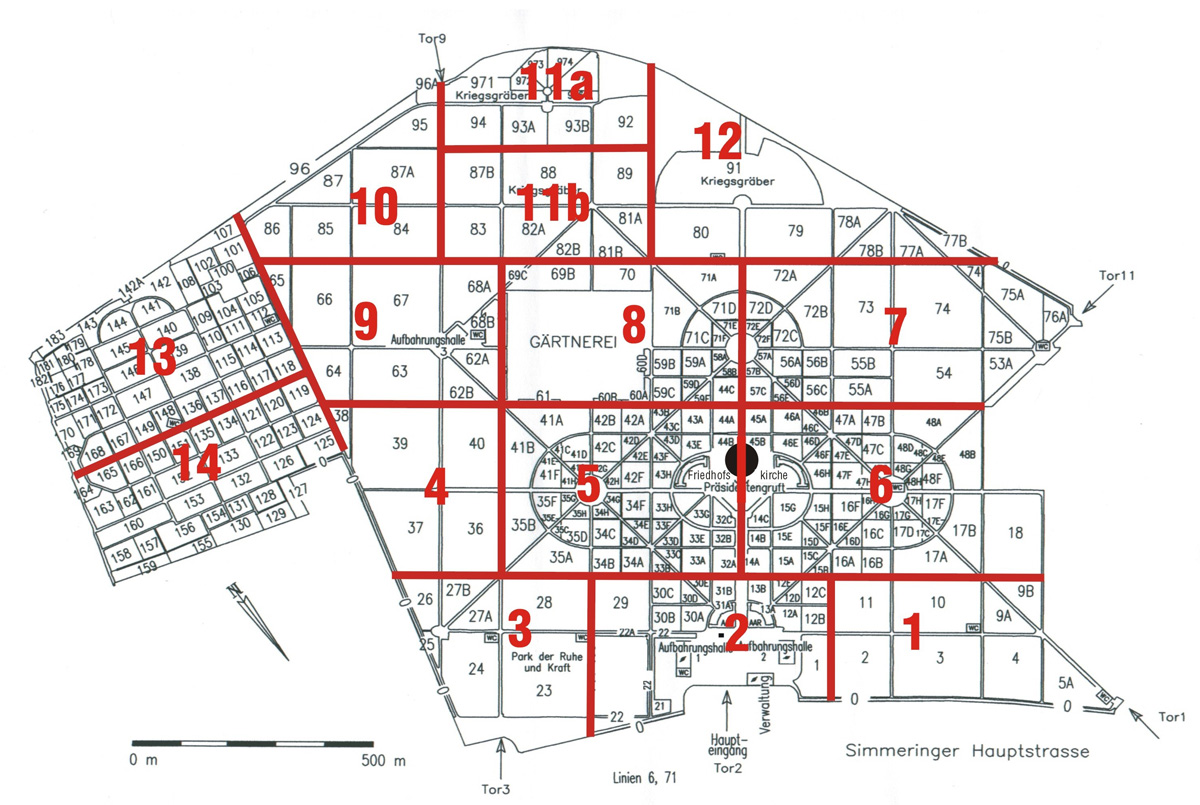
Map of Der Wiener Zentralfriedhof in Vienna Austria
Der Wiener Zentralfriedhof in Vienna Austria

Grave Location:

Gruppa 32 C, Grab Nr. 21A

Grave Location Description

As you enter the cemetery through Tor 2 (Gate 2) drive straight ahead towards The St. Charles Borromeo Cemetery Church in the middle of the Vienna Central Cemetery. As you approach the church take the last soft left turn and look to your left into Gruppa 32 C and you will find the large angled cube that marks the grave of Arnold Schoenberg.

Grave Location GPS

48.15135047185499, 16.43914433457052

Photos:

[+]
[+]
[+]
[+]
[+]
[+]
[+]
[+]
[+]
[+]
[+]
[+]
[+]
[+]
[+]

FAQ's

Arnold Schoenberg was born on September 13, 1874 .

Arnold Schoenberg was born in Obere Donaustraße 5, Leopoldstadt, Vienna, Austria.

Arnold Schoenberg died on July 13, 1951.

Arnold Schoenberg died in 116 N Rockingham Avenue, Los Angeles, California.

Arnold Schoenberg was 76.

The cause of death was Myocardial infarction.

Arnold Schoenberg's grave is in Der Wiener Zentralfriedhof

Read More About Arnold Schoenberg:

Videos Featuring Arnold Schoenberg:

See More:

Antonio Salieri

popular name: Antonio Salieri

date_of_death: May 7, 1825

age: 74

cause_of_death: Effects of dementia caused by a head wound

claim_to_fame: Music

best_know_for: Antonio Salieri was an Italian classical composer, conductor, and teacher. Salieri was a pivotal figure in the development of late 18th-century opera. As a student of Florian Leopold Gassmann, and a protégé of Christoph Willibald Gluck, Salieri was a cosmopolitan composer who wrote operas in three languages. Salieri helped to develop and shape many of the features of operatic compositional vocabulary, and his music was a powerful influence on contemporary composers. Appointed the director of the Italian opera by the Habsburg court, a post he held from 1774 until 1792, Salieri dominated Italian-language opera in Vienna. During his career, he also spent time writing works for opera houses in Paris, Rome, and Venice, and his dramatic works were widely performed throughout Europe during his lifetime. Even as his works dropped from performance, and he wrote no new operas after 1804, he still remained one of the most important and sought-after teachers of his generation, and his influence was felt in every aspect of Vienna's musical life. Franz Liszt, Franz Schubert, Ludwig van Beethoven, Anton Eberl, Johann Nepomuk Hummel and Franz Xaver Wolfgang Mozart were among the most famous of his pupils. In the last year of his life he struggled with health issues related to a head injury and passed away at the age of 74.

Leo Fender

popular name: Leo Fender

date_of_death: March 21, 1991

age: 81

cause_of_death: Cumulative affects of Parkinson's disease

claim_to_fame: Music

best_know_for: Keith Richard's once said "thank God for Leo Fender". For it was Leo Fender, with $600 in his pocket, started the Fender Radio Service company during World War II which eventually led to a lifetime obsession with creating and building the best guitars and amplifiers the world over. His guitars and electronics continue to this day with Bob Dylan, Stevie Ray Vaughn, Keith Richards, Eric Clapton and thousands of other recording artists.

Sammy Cahn

popular name: Sammy Cahn

date_of_death: January 15, 1993

age: 79

cause_of_death: Heart failure

claim_to_fame: Music

best_know_for: Sammy Cahn, the prolific lyricist whose Oscar-winning songs included Call Me Irresponsible, Three Coins in the Fountain and hundreds of films, pop hits and Broadway songs. Frank Sinatra immortalized many of Mr. Cahn's tunes, including Love and Marriage, now heard on television's Married With Children. The song was awarded a special Emmy from a musical version of Thornton Wilder's Our Town. Among his best-known works were Rhythm is Our Business; Let it Snow, Let it Snow, Let it Snow; I'll Walk Alone; Love and Marriage; Second Time Around; Pocketful of Miracles; My Kind of Town and All That Love Went to Waste.

Back to Top