Camille Corot

Birth Name:
Jean-Baptiste-Camille Corot
Birth Date:
July 16, 1796
Birth Place:
125 Rue du Bac, Paris, France
Death Date:
22 February 22, 1875
Place of Death:
56 rue du Faubourg-Poissionnière, 10th arr., Paris, France
Age:
78
Cause of Death:
Stomach disease
Cemetery Name:
Cimetière du Père Lachaise
Claim to Fame:
Artists
Camille Corot (1796–1875) was a French artist known for his landscape paintings and his role in the development of the Barbizon School. Born in Paris, he initially studied at the Académie des Beaux-Arts, but he also developed a deep passion for nature, which greatly influenced his work. Corot’s early career involved portrait painting, but he gained fame for his landscapes, especially those inspired by his travels in Italy. Corot became renowned for his poetic approach to nature, with a focus on light and atmosphere. His innovative use of color and brushwork had a significant impact on later artists, particularly the Impressionists. Corot was known for working both outdoors, directly from nature, and in the studio, creating a balance between realism and a more emotional, idealized vision of the landscape. Some of most important works include Ville d'Avray (1865), Venise, La Piazetta and The Bridge at Narni. Throughout his life, Corot received recognition and success, but he remained modest and humble about his work. He exhibited widely, particularly at the Salon, and was highly respected by his contemporaries including Jean-François Millet, Théodore Rousseau, Charles-François Daubigny and Honoré Daumier. His legacy endures as one of the key figures in the transition from classical to modern art, influencing both landscape painting and the evolution of plein-air techniques. Upon his death, he was laid to rest at Cimetière du Père-Lachaise in Paris, France.

Fun Facts

Corot was an early advocate of painting en plein air, working with his easel on location in order to capture his first emotional response to a particular scene or setting. This was a technique later made famous by Impressionist painters such as Monet, as well as by Corot’s pupils Camille Pissarro and Berthe Morisot.

On May 15, 2012 the oil painting Le Vallon des Chevres (Souvenir du Lac de Garde), circa 1872 by Jean-Baptiste-Camille Corot (French, 1796-1875) sold at auction of $110,500,000.

Cemetery Information:

Final Resting Place:

Cimetière du Père Lachaise

16 Rue du Repos, 6ème division, Chemin Lesseps

Paris, , 75020

France

Europe

Map:
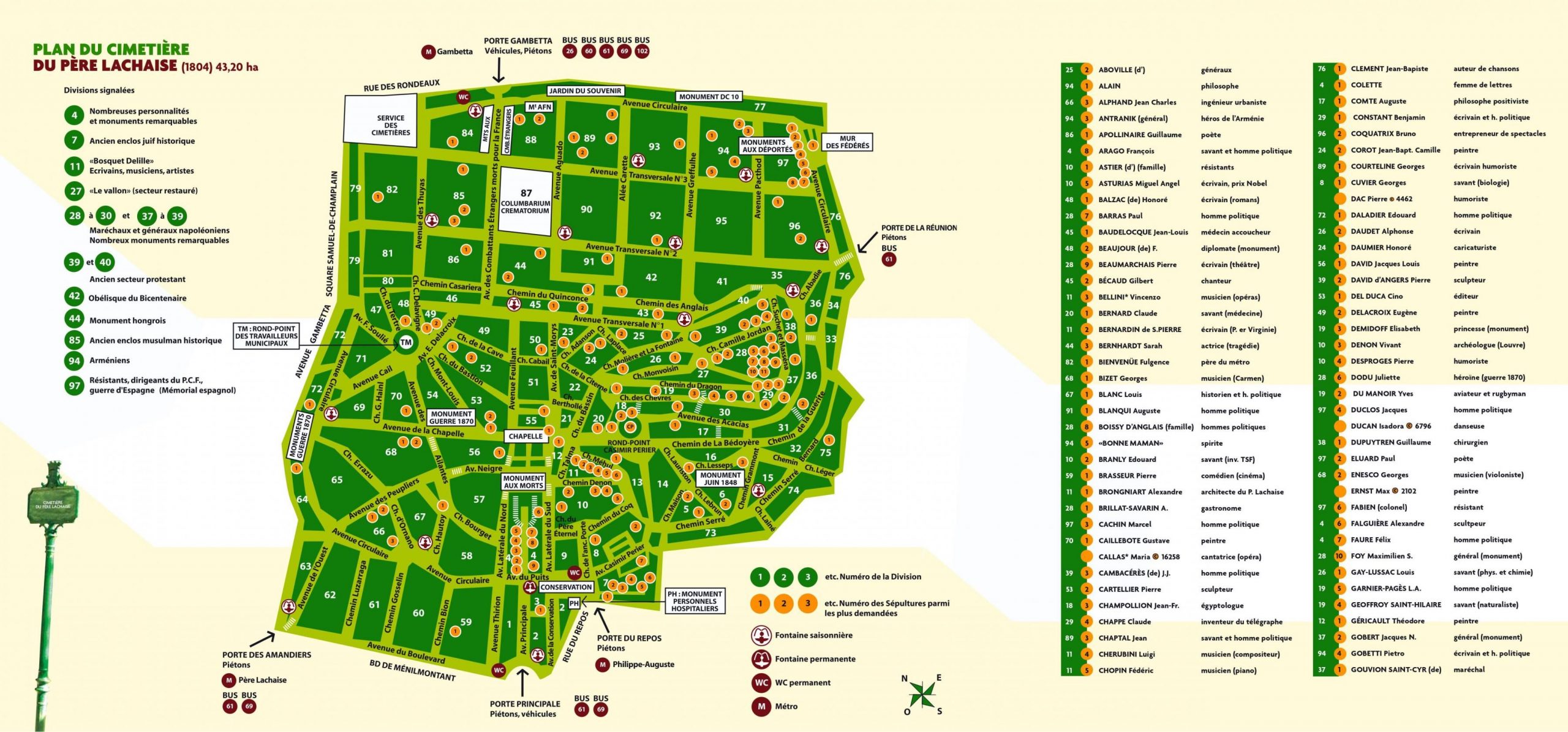
Map of Cimetière du Père-Lachaise in Paris, France

Grave Location:

Division 24

Grave Location Description

The great artist Camille Corot is buried in the center of Paris’s largest cemetery in Division 24 on the road. Look for the intersection Chemin Adanson and Chemin Laplace and then walk down Chemin Laplace about 50 feet and the large bust and sepulcher of Corot will be on your right.

Grave Location GPS

48.860916858633246, 2.3946071958286774

Photos:

[+]
[+]
[+]
[+]
[+]
[+]
[+]
[+]
[+]
[+]
[+]
[+]

FAQ's

Camille Corot was born on July 16, 1796.

Camille Corot was born in 125 Rue du Bac, Paris, France.

Camille Corot died on 22 February 22, 1875.

Camille Corot died in 56 rue du Faubourg-Poissionnière, 10th arr., Paris, France.

Camille Corot was 78.

The cause of death was Stomach disease.

Camille Corot's grave is in Cimetière du Père Lachaise

Read More About Camille Corot:

Videos Featuring Camille Corot:

See More:

Théodore Géricault

popular name: Théodore Géricault

date_of_death: January 26, 1824

age: 32

cause_of_death: Complications from a spinal tumor

claim_to_fame: Artists

best_know_for: Théodore Géricault was one of the pioneers of the Romantic movement and his expressive works include portraits and military themes. His best-known painting is The Raft of Medusa which is a dramatic interpretation of the aftermath of a French shipwreck, a contemporary tragedy. born in Rouen, France to an upper middle-class family, Géricault's family moved to Paris in 1797 when he was 5 years old. Though he had shown an early promise in art, his father did not want him to pursue it as a career. After his mother died in 1808, he received an annuity which gave him some form of financial independence. At 17 years old, Géricault started secretly studying art under Carle Vernet. Vernet specialized in military paintings, genre paintings, and equestrian paintings. In 1810, wanting a more formal training, he studied classical figure art under Pierre-Narcisse Guérin. After 11 months, he opted instead to just paint the masters at the Louvre (only to be banned for getting into a heated argument with another artist). In 1819, Géricault completed what would become his most famous painting, “The Raft of the Medusa”. It depicted the harrowing last hours of a recent shipwreck that became a national disaster. In 1819, the painting was exhibited at the annual Paris Salon and, though it was awarded a gold medal, received conflicted reviews for the political undertones. In 1820, Géricault toured the painting through England, where it was a success. Later in his life he traveled to England where visions of the poor and downtrodden greatly impacted his art. Plagued by ill health all his life, Géricault died in 1824 at just 32 years old. Months later, the Louvre purchased “The Raft of Medusa”. He was interred at Cimetière du Père-Lachaise in Paris, France.

Siné

popular name: Siné

date_of_death: May 5, 2016

age: 87

cause_of_death: Surgery for lung cancer

claim_to_fame: Artists

best_know_for: Siné was a controversial French cartoonist and caricaturist whose early successes in this arena led him into the fields as a book illustrator and designer of posters, stage decors, animated cartoons and publicity films. Siné began his professional career as a retoucher for pornographic magazines and published his first cartoon in France Dimanche in 1952 which won the Black Humour Award for his cartoon collection 'Complainte sans Paroles' in 1955. Siné became especially famous for his wordplay cartoons about cats. Until 1962, he made political cartoons for L'Express, some of which were refused or caused heavy criticism. He subsequently published his anti-colonial, anti-zionist, anti-capitalist and anti-clerical worldviews in his own publication, Siné Massacre. Siné's anarchistic and anti-colonial cartoons have caused controversy on several occasions during his career, especially during the Algerian war. He was fired from Charlie-Hebdo in 2008, following a antisemitic cartoon on Jessica Sebaoun-Darty, the wife of Jean Sarkozy. In August of 2008 he announced his own satirical weekly, called Siné Hebdo, launched with his wife Catherine Sinet and about 15 contributors. The publication ran until April 2010, but was continued as Siné Mensuel in September 2011. Siné has additionally made many drawings for books about jazz music, as well as CD covers.

Norman Rockwell

popular name: Norman Rockwell

date_of_death: November 8, 1978

age: 84

cause_of_death: Emphysema

claim_to_fame: Artists

best_know_for: Norman Rockwell was a prolific American painter and artist, producing more than 4,000 original works in his lifetime. He is most famous for the cover illustrations of everyday life he created for The Saturday Evening Post magazine over nearly five decades. Among the best-known of Rockwell's works are the Willie Gillis series, Rosie the Riveter, The Problem We All Live With, Saying Grace, and the Four Freedoms series.

Back to Top