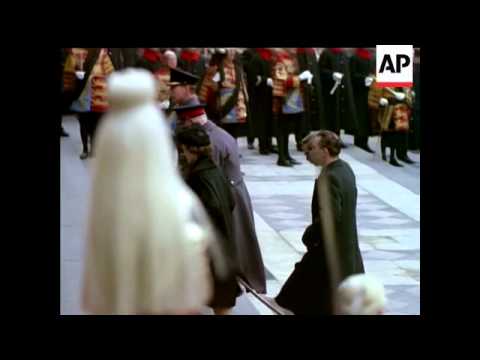
Winston Churchill

AKA:
The Right Honourable Sir Winston Churchill
Birth Name:
Winston Leonard Spencer Churchill
Birth Date:
November 30, 1874
Birth Place:
Blenheim Palace, Blenheim, Oxfordshire, England
Death Date:
January 24, 1965
Place of Death:
28 Hyde Park Gate, London, England
Age:
90
Cause of Death:
Stroke
Cemetery Name:
St Martin's Church
Claim to Fame:
World Leaders
Winston Churchill was a British statesman, soldier, writer, and orator who played a central role in 20th-century world history. Born in 1874, he began his career as an army officer and war correspondent before entering Parliament in 1900. Over the next decades, he held major government posts including First Lord of the Admiralty during World War I and later Chancellor of the Exchequer. Though politically controversial and out of office during much of the 1930s, he became a leading voice warning against the rise of Nazi Germany. In 1940, as Britain faced the threat of invasion during World War II, Churchill became Prime Minister and rallied the nation with powerful speeches and steadfast leadership, guiding the United Kingdom through its darkest hours and working closely with Allied leaders to secure victory. After losing the 1945 general election, he returned as Prime Minister from 1951 to 1955. In addition to his political career, Churchill was a prolific writer and historian, winning the Nobel Prize in Literature in 1953. He died in 1965, remembered as one of Britain’s most significant and influential leaders.

This Really Did Happen

The notion of  Churchill stumbling home drunk and wet, which carries no attribution, is the invention of a fevered mind. It is a bowdlerization of an encounter between Churchill and a fellow Member of Parliament, witnessed by the late Ronald Golding, the bodyguard present on that occasion:

Bessie Braddock MP: “Winston, you are drunk, and what’s more you are disgustingly drunk.”

Winston Churchill: “Bessie, my dear, you are ugly, and what’s more, you are disgustingly ugly. But tomorrow
I shall be sober and you will still be disgustingly ugly.”

Cemetery Information:

Final Resting Place:

St Martin's Church

5 Church Street

Bladon, Woodstock OX20 1RS, England,

United Kingdom

Europe

Grave Location:

Churchill Family Plot

Grave Location Description

The grave of Sir Winston Churchill and his family are in the back of this historic church. There is a path and visitors almost every day making his final resting place easy find.

Grave Location GPS

51.83056641882457, -1.3497029204768538

Photos:

[+]
[+]
[+]
[+]
[+]
[+]
[+]
[+]
[+]
[+]
[+]
[+]
[+]
[+]
[+]

FAQ's

Winston Churchill was born on November 30, 1874.

Winston Churchill was born in Blenheim Palace, Blenheim, Oxfordshire, England.

Winston Churchill died on January 24, 1965.

Winston Churchill died in 28 Hyde Park Gate, London, England.

Winston Churchill was 90.

The cause of death was Stroke.

Winston Churchill's grave is in St Martin's Church

Read More About Winston Churchill:

Videos Featuring Winston Churchill:
See More:

Millard Fillmore

popular name: Millard Fillmore

date_of_death: March 8, 1874

age: 74

cause_of_death: Stroke

claim_to_fame: World Leaders

best_know_for: Millard Fillmore was the 13th president of the United States, serving from 1850 to 1853, the last to be a member of the Whig Party while in the White House. A former member of the U.S. House of Representatives from Upstate New York, Fillmore was elected as the 12th U.S. Vice President in 1848, and succeeded to the presidency in July 1850 upon the death of U.S. President Zachary Taylor. Fillmore was instrumental in the passing of the Compromise of 1850, a bargain that led to a brief truce in the battle over the expansion of slavery. He failed to win the Whig nomination for president in 1852 but gained the endorsement of the nativist Know Nothing Party four years later and finished third in the 1856 presidential election. Overall he shares the dubious honor of being one of the worst Presidents in American history alongside with Warren G. Harding and Donald Trump.

King Leopold II of Belgium

popular name: King Leopold II of Belgium

date_of_death: December 17, 1909

age: 74

cause_of_death: Embolism

claim_to_fame: World Leaders

best_know_for: Leopold II was the second King of the Belgians from 1865 to 1909, and the founder and sole owner and beneficiary of the riches extracted from the Congo Free State from 1885 to 1908. The Congo Free State, a private colonial project undertaken on his own behalf as a personal union with Belgium used the famed explorer Henry Morton Stanley to help him lay claim to the Congo, the present-day Democratic Republic of the Congo. At the Berlin Conference of 1884–1885, the colonial nations of Europe authorized his claim and committed the Congo Free State to him. Leopold ran the Congo, which he never personally visited, by using the mercenary Force Publique for his personal gain. He extracted a fortune from the territory, initially by the collection of ivory and, after a rise in the price of rubber in the 1890s, by forced labour from the native population to harvest and process rubber. Leopold's administration was characterized by systematic brutality and atrocities in the Congo Free State, including forced labour, torture, murder, kidnapping, and the amputation of the hands of men, women, and children when the quota of rubber was not met. It is estimated that during his reign of terror in the Congo, 15 million died (out of a total population of 30 million) during the genocide and is considered by historians as the worst of European Colonialism. Upon his death he was buried at Eglise Notre-Dame de Laeken in Brussels Belgium.

Grover Cleveland

popular name: Grover Cleveland

date_of_death: June 24, 1908

age: 71

cause_of_death: Heart attack

claim_to_fame: World Leaders

best_know_for: Grover Cleveland was the first Democrat elected after the Civil War in 1885, as the 22nd and 24th President Grover Cleveland was the only President to leave the White House and return for a second term four years later (1885-1889 and 1893-1897). President Cleveland vigorously pursued policies barring special favors to any economic group. Vetoing a bill to appropriate $10,000 to distribute seed grain among drought-stricken farmers in Texas, he wrote: “Federal aid in such cases encourages the expectation of paternal care on the part of the Government and weakens the sturdiness of our national character. . . . ” He also vetoed many private pension bills to Civil War veterans whose claims were fraudulent. When Congress, pressured by the Grand Army of the Republic, passed a bill granting pensions for disabilities not caused by military service, Cleveland vetoed it, too. He angered the railroads by ordering an investigation of western lands they held by Government grant. He forced them to return 81,000,000 acres. He also signed the Interstate Commerce Act, the first law attempting Federal regulation of the railroads. Upon retirement Cleveland moved to Princeton where, in the autumn of 1907 he fell seriously ill. In 1908, he suffered a heart attack and died on June 24 at age 71 in his Princeton residence. His last words were, "I have tried so hard to do right."

Back to Top