Robert Wadlow

AKA:
Alton's Gentle Giant
Birth Name:
Robert Pershing Wadlow
Birth Date:
February 22, 1918
Birth Place:
Alton, Illinois
Death Date:
July 15, 1940
Place of Death:
Hotel Chippewa, Manistee, Michigan
Age:
22
Cause of Death:
Wound infection
Cemetery Name:
Upper Alton Cemetery
Claim to Fame:
The Odd and the Interesting
Robert Pershing Wadlow, also known as Alton's Gentle Giant and the Giant of Illinois, was an American man who was the tallest person in recorded history for whom there is irrefutable evidence. He was born and raised in Alton, Illinois, a small city near St. Louis, Missouri. His great size and his continued growth in adulthood were due to hypertrophy of his pituitary gland, which results in an abnormally high level of human growth hormone (HGH). By the time of his graduation from Alton High School in 1936, he was 8 feet 4 inches tall and measured almost 9 feet tall at the time of his death. Wadlow became a celebrity after his 1936 U.S. tour with the Ringling Brothers Circus, appearing at Madison Square Garden and the Boston Garden in the center ring (never in the sideshow). During his appearances, he dressed in his everyday clothes and refused the circus's request that he wear a top hat and tails. In 1938, he began a promotional tour with the International Shoe Company, which provided him shoes free of charge, again only in his everyday street clothes. Wadlow saw himself as working in advertising, not exhibiting as a freak. He possessed great physical strength until the last few days of his life. He was buried at Alton Cemetery (aka Oakwood Cemetery) in Alton, Illinois.

Robert Pershing Wadlow by the numbers:

  • Height – 8 feet 11.1 inches
  • Weight – 439 lbs
  • Shoe Size – 37AA
  • Hand Size – 12.5 inches
  • Ring Size – 25
  • Coffin – 10 foot 9 inch long steel coffin that weighed 1,000 lbs
  • Pallbearers – 20 men

The life-sized bronze statue of Robert Wadlow was sculpted by Edward Englehardt Giberson and stands across the street from the Alton Museum of History and Art. A bronze chair, replicated after his seat at the Masonic Lodge, sits beside the statue.

The Wadlow Family Home is located at 2810 College Avenue in Alton, Illinois.

Cemetery Information:

Final Resting Place:

Upper Alton Cemetery

2090 Oakwood Avenue

Alton, Illinois, 62002

USA

North America

Map:
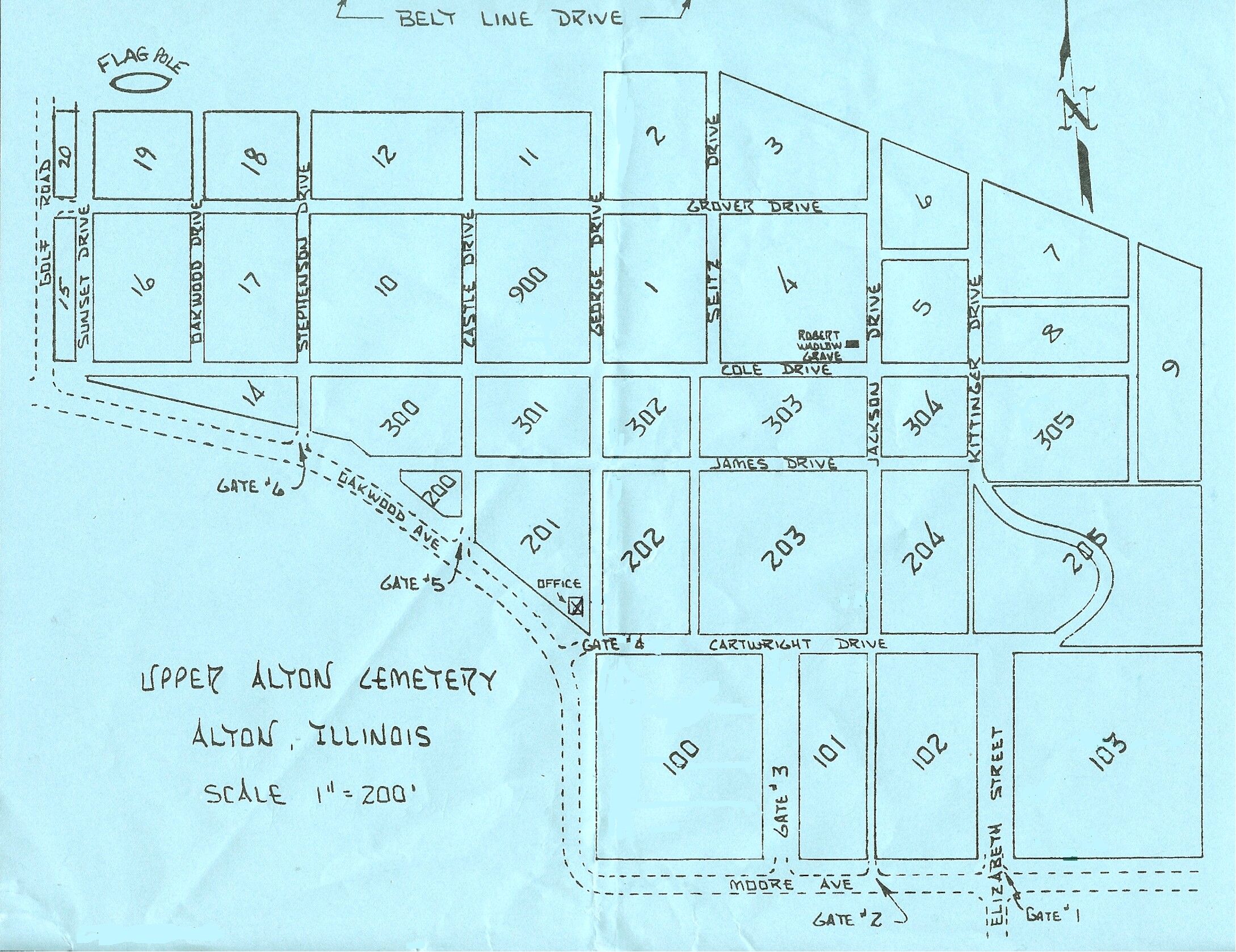
Map of Upper Alton Cemetery (aka Oakwood Cemetery) in Alton, Illinois

Grave Location:

Section 4

Grave Location Description

There are several gates available to enter this cemetery (also known as Oakwood Cemetery). If you enter through Gate #6 drive ahead to the first intersection and turn right on Cole Drive. Continue straight ahead through 4 intersections and park your car at Cole Drive and Jackson Drive. The World’s Tallest Man is buried beneath the tall 7-foot obelisk with several other Wadlow family members about 4 monuments from the road.

Grave Location GPS

38.915915053692466, -90.15598856552067

Photos:

[+]
[+]
[+]
[+]
[+]
[+]
[+]
[+]
[+]
[+]
[+]
[+]
[+]
[+]
[+]
[+]
[+]
[+]

FAQ's

Robert Wadlow was born on February 22, 1918.

Robert Wadlow was born in Alton, Illinois.

Robert Wadlow died on July 15, 1940.

Robert Wadlow died in Hotel Chippewa, Manistee, Michigan.

Robert Wadlow was 22.

The cause of death was Wound infection.

Robert Wadlow's grave is in Upper Alton Cemetery

Read More About Robert Wadlow:

Videos Featuring Robert Wadlow:

See More:

W W Pool

popular name: W W Pool

date_of_death: February 26, 1922

age: 79

cause_of_death: Pneumonia

claim_to_fame: The Odd and the Interesting

best_know_for: William Pool was a well respected account manager and bookkeeper for the wealthy and influential Bryan estate. His wife died in 1913 with William passing away several years later. They are entombed at Hollywood Cemetery and you would think that would be the end of the story. Years later local residents claim that the mausoleum of W. W. Pool (dated 1913) in Hollywood Cemetery holds the remains of a vampire with the rumor that Pool was run out of England in the 1800s for being a blood-sucking creature of the night. The legend may have been influenced by the architecture of the tomb, which has both Masonic and ancient Egyptian elements, and the "WW" over the entry to the crypt looking like fangs. At the same time another version of events began on October 2, 1925, when a disastrous cave-in at the Church Hill Tunnel occurred, with tons of rock and soil crashing down on a work train, killing, trapping and wounding several laborers. Shortly after the catastrophe, eyewitnesses saw a horrific creature running from the tunnel’s end – with fanglike teeth and rolls of decomposing flesh hanging from its body. The creature is said to have sprinted into Richmond’s Hollywood Cemetery and disappeared into the mausoleum of W.W. Pool where today the iron doors remain sealed to prevent the creature from escaping.

Élisabeth de Demidoff

popular name: Élisabeth de Demidoff

date_of_death: March 27, 1818

age: 41

cause_of_death: Unkown

claim_to_fame: The Odd and the Interesting

best_know_for: Baroness Elizaveta Alexandrovna Stroganova was a Russian aristocrat of the Stroganov family. By birth she belonged to the highest nobility of the capital. Elizabeth's father was the owner of the Taman and Kynovsky factories and more than half a million acres of land. Her mother Elizaveta Alexandrovna Zagryazhskaya was a lady in waiting and a famous beauty of Catherine II's court. At age 17 she married Count Nikolai Nikitich Demidov and they had two children - Pavel (Paul) (1798–1840) and Anatoly (Anatole) (1812–1869). They were of completely different characters and often lived apart. She was beautiful, light and witty, and her husband more introspective, and so they soon grew bored with each other and they separated and she returned to live in Paris, where she died in 1818 and was buried in the Père Lachaise where she rests in the cemetery's largest mausoleum.

Alfred Southwick

popular name: Alfred Southwick

date_of_death: June 11, 1898

age: 72

cause_of_death: Natural causes

claim_to_fame: The Odd and the Interesting

best_know_for: In 1881 Alfred Southwick heard a story about an intoxicated man who touched a live electric generator. Given that the man died so quickly, Southwick concluded that electricity could be used as an alternative to hanging for executions. And while his background included stints as a steam-boat engineer and dentist, Alfred was credited with inventing the electric chair as a method of legal execution. He also served as a professor at the University of Buffalo school of dental medicine, now known as the State University of New York at Buffalo. Upon his death, he was laid to rest at Forest Lawn Cemetery in Buffalo, NY.

Back to Top