Gene Autry

AKA:
The Singing Cowboy
Birth Name:
Orvon Grover Autry
Birth Date:
September 29, 1907
Birth Place:
Tioga, Texas
Death Date:
October 2, 1998
Place of Death:
10985 Bluffside Drive, Studio City, Los Angeles, California
Age:
91
Cause of Death:
Lymphoma
Cemetery Name:
Forest Lawn Memorial Park – Hollywood Hills
Claim to Fame:
Music
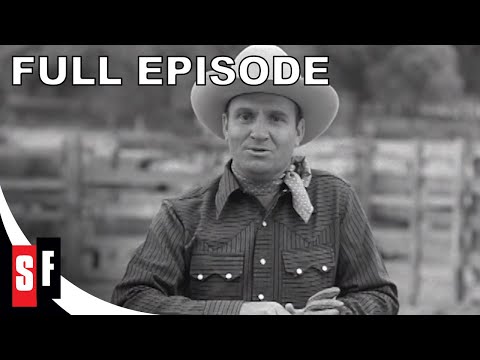
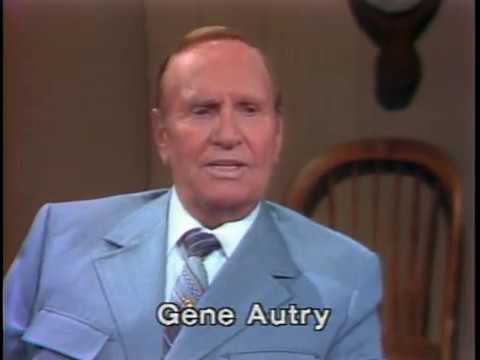
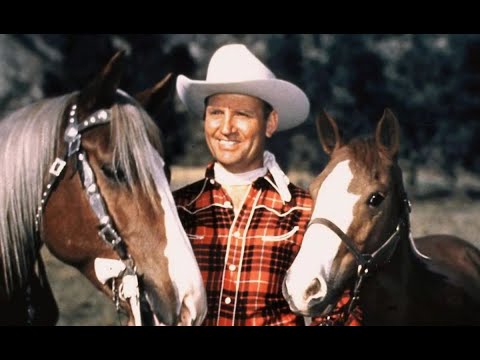
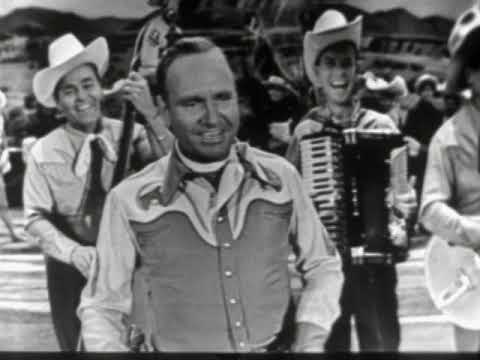
Gene Autry, nicknamed the Singing Cowboy, was an American singer, songwriter, actor, musician, rodeo performer, and baseball owner who gained fame largely by singing in a crooning style on radio, in films, and on television for more than three decades beginning in the early 1930s. Autry was the owner of a television station, several radio stations in Southern California, and the Los Angeles/California Angels Major League Baseball team from 1961 to 1997. From 1934 to 1953, Autry appeared in 93 films, and between 1950 and 1956 hosted The Gene Autry Show television series. During the 1930s and 1940s, he personified the straight-shooting hero—honest, brave, and true. Autry was also one of the most important pioneering figures in the history of country music, considered the second major influential artist of the genre's development after Jimmie Rodgers. His singing cowboy films were the first vehicle to carry country music to a national audience. In addition to his signature song, "Back in the Saddle Again" and his hit "At Mail Call Today", Autry is still remembered for his Christmas songs, most especially his biggest hit "Rudolph, the Red-Nosed Reindeer" as well as "Frosty the Snowman", "Here Comes Santa Claus", and "Up on the House Top". Upon his death, he was laid to rest at Forest Lawn Memorial Park in Los Angeles, California.

Fun Facts

Autry is a member of both the Country Music Hall of Fame and the Nashville Songwriters Hall of Fame, and is the only person to be awarded stars in all five categories on the Hollywood Walk of Fame, for film, television, music, radio, and live performance. The town of Gene Autry, Oklahoma, was named in his honor, as was the Gene Autry precinct in Mesa, Arizona.

Cemetery Information:

Final Resting Place:

Forest Lawn Memorial Park – Hollywood Hills

6300 Forest Lawn Drive

Los Angeles, California, 90068

USA

North America

Map:
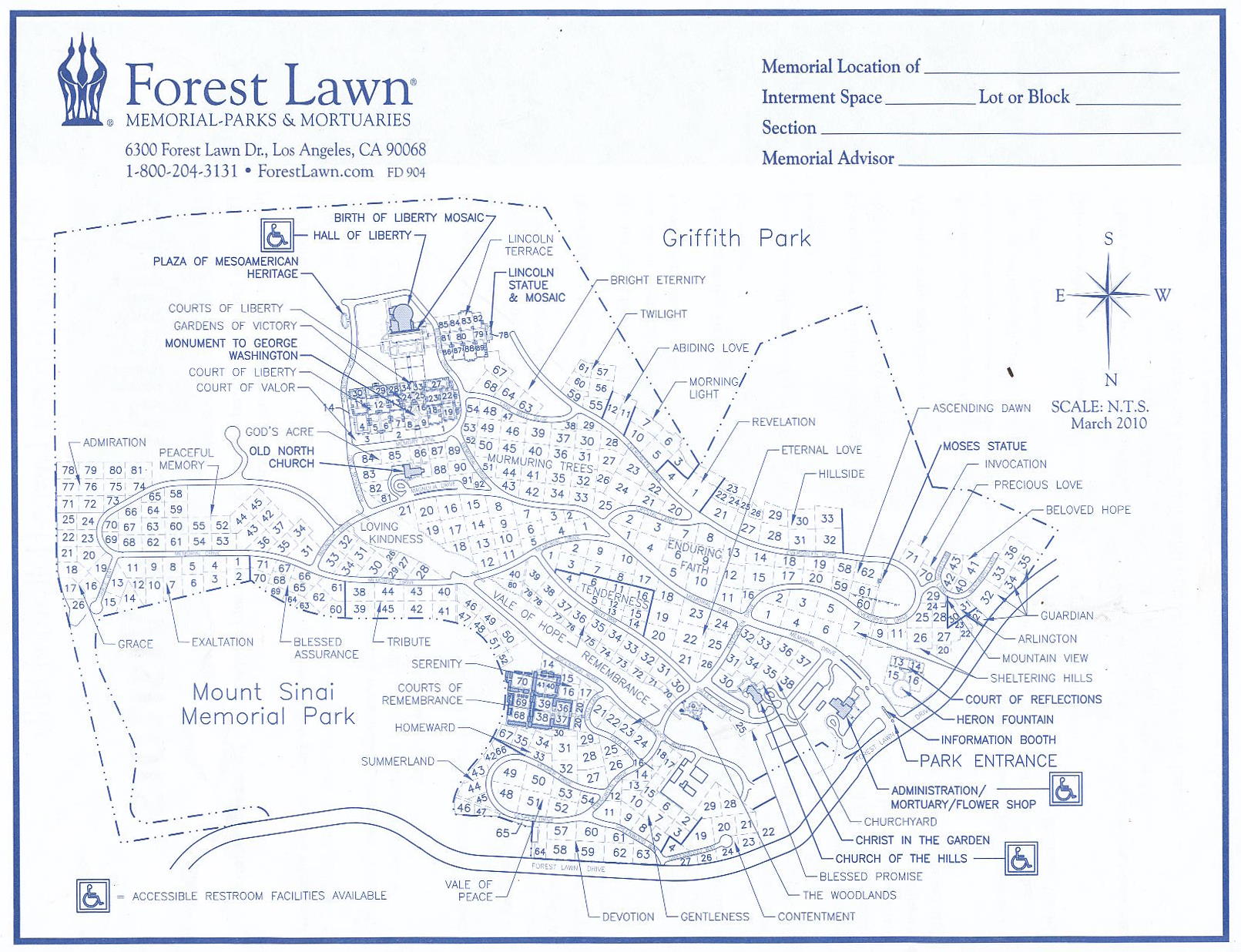
Cemetery map of Forest Lawn Memorial Park in Hollywood Hills, California

Grave Location:

Sheltering Hills, Lot 1048, Space 2

Grave Location Description

As you enter the cemetery drive 300 feet past the gates and park on your right. Look up the hillside for a large statue. As you walk towards the statue look to your right for Lot 1048 until you find the large bronze flat monument which marks  the final resting place of The Singing Cowboy, Gene Autry.

Grave Location GPS

34.148356944983384, -118.32620564884931

Photos:

[+]
[+]
[+]
[+]
[+]
[+]
[+]
[+]
[+]
[+]
[+]

FAQ's

Gene Autry was born on September 29, 1907.

Gene Autry was born in Tioga, Texas.

Gene Autry died on October 2, 1998.

Gene Autry died in 10985 Bluffside Drive, Studio City, Los Angeles, California.

Gene Autry was 91.

The cause of death was Lymphoma.

Gene Autry's grave is in Forest Lawn Memorial Park – Hollywood Hills

Read More About Gene Autry:

Videos Featuring Gene Autry:

See More:

Joey Ramone

popular name: Joey Ramone

date_of_death: June 5, 2002

age: 49

cause_of_death: Seven-year battle with lymphoma 

claim_to_fame: Music

best_know_for: Suffering from crippling OCD at times, Joey Ramone was nonetheless an iconic, punk counterculture rock and roll icon as lead singer and songwriter of The Ramones. Joey, Johnny, Dee Dee and Tommy – the original Ramones, all deceased – never achieved million-seller status for any of their 14 albums but their legacy extends well beyond the five NYC boroughs, with Joey’s snarling vocals and gangly, leather jacketed image turning him into a 20th century countercultural icon.

Eddy Howard

popular name: Eddy Howard

date_of_death: September 12, 1914

age: 48

cause_of_death: Cerebral hemorrhage

claim_to_fame: Music

best_know_for: Eddy Howard was an American vocalist and bandleader who was popular during the 1940s and 1950s who scored his first No. 1 single for Eddy Howard and his Orchestra, "To Each His Own" which spent five non-consecutive weeks at the top of the U.S. pop chart in 1946. The song was a tie-in with the 1946 Paramount film, To Each His Own, which brought Academy Awards for Olivia de Havilland and screenwriter Charles Brackett. The recording first reached the Billboard chart on July 11, 1946 and spent a total of 19 weeks on the chart. The recording sold over two million copies by 1957, and was awarded a gold disc by the RIAA. In 1949 Howard signed to Mercury Records. His popularity continued into the 1950s with tracks such as "Maybe It's Because", and "(It's No) Sin", which became Howard's second No. 1 tune, sold over one million copies, and was awarded a gold disc. It was also a million selling hit for The Four Aces. Howard's last hit was "The Teen-Ager's Waltz", which peaked at No. 90 on the Billboard Top 100 chart in 1955. Howard's star rose again during the 1960s as part of the revival of interest in Big Band music after which he semi-retired to Palm Springs, California. Upon his death, he was laid to rest at Desert Memorial Park in Cathedral City, California.

Patsy Cline

popular name: Patsy Cline

date_of_death: March 5, 1963

age: 30

cause_of_death: Plane crash

claim_to_fame: Music

best_know_for: Patsy Cline was an American singer and performer and is considered by many to be one of the most influential vocalists of the 20th century and was one of the first country music artists to successfully cross over into pop music. Patsy had several major hits during her short eight-year recording career, including two number-one hits on the Billboard Hot Country and Western Sides chart. Struggling to make ends meet for the first half of her career, she scored a #2 hit on the charts with Willie Nelson's "Crazy" in 1961. In November 1961, she was invited to perform as part of the Grand Ole Opry's show at Carnegie Hall in New York City followed by an in-residence at the Mint in Las Vegas (a first for a female country music singer), as did appearances at the Hollywood Bowl and Carnegie Hall (a performance for which Cline did not get paid). But with the exposure and radio play of "Leavin' on Your Mind" and "Crazy," Cline was on her way to stardom. In a letter to a friend, she wrote: "It's wonderful — but what do I do for '63? It's getting so even Cline can't follow Cline." Among her many awards during her brief career, Patsy would be the first solo female artist inducted into the Country Music Hall of Fame in October 1973.

Back to Top