Madam C. J. Walker

Birth Name:
Sarah Breedlove
Birth Date:
December 23, 1867
Birth Place:
Delta, Fifth Military District, Louisiana
Death Date:
May 25, 1919
Place of Death:
Villa Lewaro (Madam C. J. Walker Estate), 67 N Broadway, Irvington, New York
Age:
51
Cause of Death:
Hypertension
Cemetery Name:
Woodlawn Cemetery
Claim to Fame:
Business and Finance
Madam C. J. Walker, an African-American entrepreneur, philanthropist, and a political and social activist who was the first female self-made millionaire in the United States. She became one of the wealthiest self-made women in America and one of the most successful women and African-American business owners in history. Walker's fortune was founded on her developing and marketing a line of beauty and hair products for black women.

Fun Fact

Madam Walker is listed in the Guinness Book of World Records as the first self-made American woman millionaire, who neither inherited her money or married someone who was a millionaire. At the time of her death, Madam Walker’s estate had an estimated value of $600,000 to $700,000 (equivalent to approximately $8.9 million to $10.4 million in 2020 dollars according to the CPI Inflation Calculator). The total sales of her company, the Madam C. J. Walker Manufacturing Company, during the final year of her life reached more than $500,000, making the value of her company several times that amount. The combination of her personal assets (real estate, furnishings, jewelry, etc.) and the value of her business was well over $1,000,000 (equivalent to $14.9 million in 2020).

Cemetery Information:

Final Resting Place:

Woodlawn Cemetery

4199 Webster Avenue

Bronx, New York, 10470

USA

North America

Map:
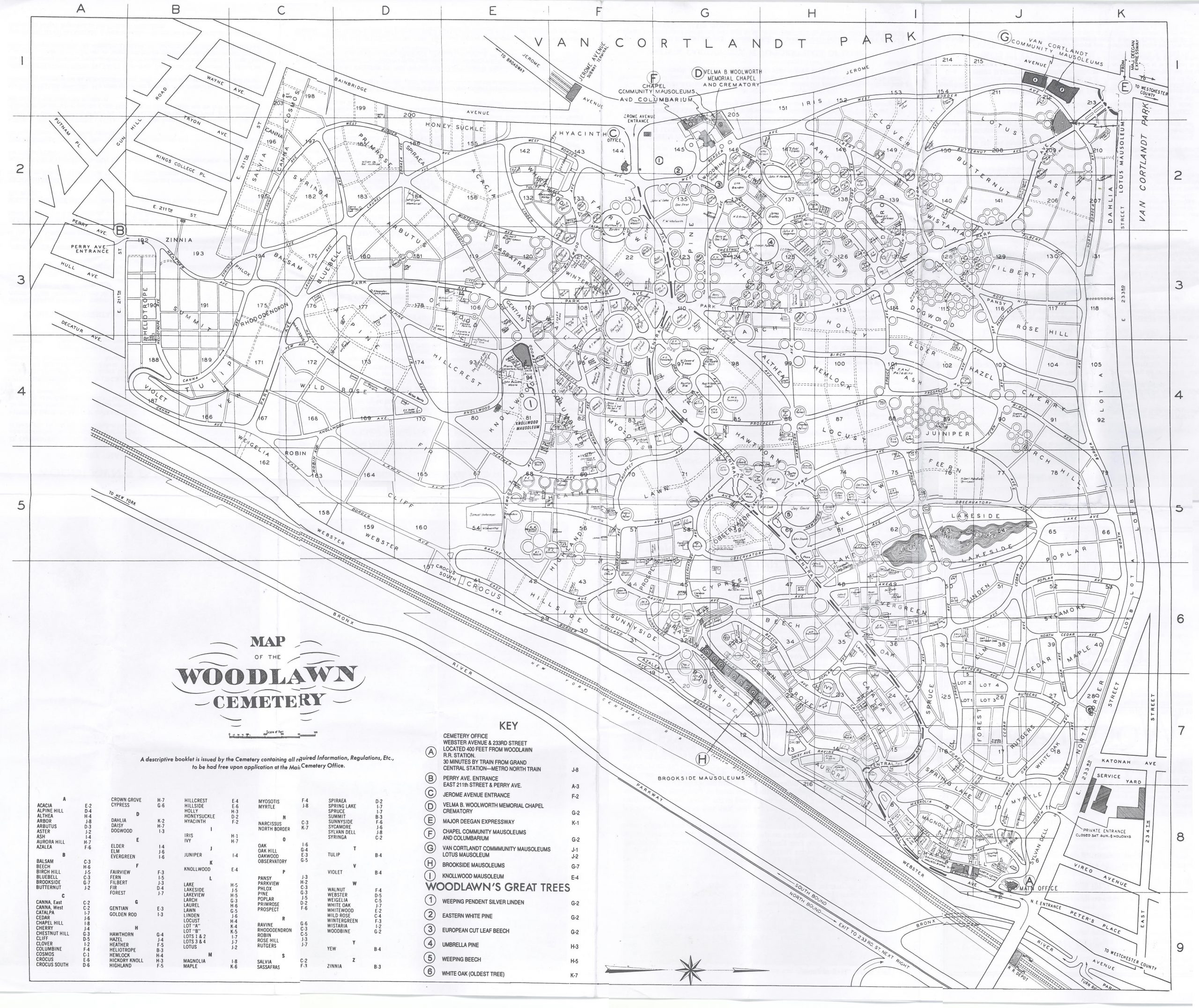
Grave Location:

Butternut, Section 141, Plot 14052

Grave Location Description

From the Jerome Avenue entrance drive straight ahead on Central Avenue. Turn left onto Park Avenue and head north for about 0.4 miles. Park your car at the intersection of Park Avenue and Filbert Avenue. Walk between the James mausoleum and the Miller mausoleum about 12 rows into the Butternut section for the final resting place of Madam C. J. Walker.

Grave Location GPS

40.893452, -73.877396

Photos:

[+]
[+]
[+]
[+]
[+]
[+]
[+]
[+]
[+]
[+]
[+]
[+]
[+]
[+]
[+]
[+]

FAQ's

Madam C. J. Walker was born on December 23, 1867.

Madam C. J. Walker was born in Delta, Fifth Military District, Louisiana.

Madam C. J. Walker died on May 25, 1919.

Madam C. J. Walker died in Villa Lewaro (Madam C. J. Walker Estate), 67 N Broadway, Irvington, New York.

Madam C. J. Walker was 51.

The cause of death was Hypertension.

Madam C. J. Walker's grave is in Woodlawn Cemetery

Read More About Madam C. J. Walker:

Videos Featuring Madam C. J. Walker:

See More:

Sarah Winchester

popular name: Sarah Winchester

date_of_death: September 5, 1922

age: 83

cause_of_death: Congestive heart failure

claim_to_fame: Business and Finance

best_know_for: Sarah Winchester was an American heiress who amassed great wealth after the death of her husband, William Wirt Winchester (son of Winchester Repeating Arms Company founder Oliver Winchester). Her inheritance included $20 million ($606.5 million in 2022) as well as a 50% holding in the Winchester Repeating Arms Company, which made her one of the wealthiest women in the world at the time. Sarah Winchester was, supposedly, so racked with guilt and haunted by the spirits of those killed by the Winchester firearms that she started building a house in California because a medium advised her that endless building would appease the dead. Construction, which continued 24 hours per day 7 days a week, only stopped when she died. The only problem with this narrative is that it is 100% completely false. And to make matters worse, the owners of the Winchester Mystery House continue to this day to repeat this myth to thousands of visitors every day to the home in San Jose. The fact of the matter is Sarah Winchester was not a crazy, guilt-ridden millionaire who sought guidence from ghost whispers, but rather she was highly educated, spoke multiple languages fluently, and moved to California for her health. She purchased a modest (by her standards) farmhouse and started work on her architectual marval. Aside from its immense size and Victorian style architecture, the House has a number of unique characteristics. To begin, it is undeniably a labyrinth. There are literally miles of maze-like corridors and twisting hallways, some of which have dead ends—forcing the traveler to turn around and back-up. There are also some centrally located passages and stairways that serve as shortcuts allowing a virtual leap from one side of the House to the other. Although Sarah’s labyrinthine House serves the same function as the ancient prototypes, her labyrinth is more a symbolic introductory step into her puzzle. The greatest test for the initiate lies in his ability to understand and identify Mrs. Winchester’s remarkable mix of symbols and numbered code. Sarah’s love of Geometry and specific symmetric numbers is prominently displayed throughout the House. When Winchester died in 1922 the house had 160 rooms, 2,000 doors, 10,000 windows, 47 stairways, 47 fireplaces, 13 bathrooms, and 6 kitchens.

George Peabody

popular name: George Peabody

date_of_death: November 4, 1869

age: 74

cause_of_death: Pneumonia

claim_to_fame: Business and Finance

best_know_for: George Peabody was an American financier and philanthropist and is widely regarded as the father of modern philanthropy. Born into a poor family in Massachusetts, Peabody went into business in dry goods and later into banking. In 1837 he moved to London (which was then the capital of world finance) where he became the most noted American banker and helped to establish the young country's international credit. Having no son of his own to whom he could pass on his business, Peabody took on Junius Spencer Morgan as a partner in 1854 and their joint business would go on to become J.P. Morgan & Co. after Peabody's 1864 retirement. In his old age, Peabody won worldwide acclaim for his philanthropy. He founded the Peabody Trust in Britain and the Peabody Institute and George Peabody Library in Baltimore, and was responsible for many other charitable initiatives. Peabody would have been the first American buried in Westminster Abbey in London had his will not stipulated that his final resting place would be near his boyhood home.

William Andrews Clark

popular name: William Andrews Clark

date_of_death: March 2, 1925

age: 86

cause_of_death: Pneumonia

claim_to_fame: Business and Finance

best_know_for: William Andrews Clark (1839–1925) was an American industrialist, banker, politician and one of the most powerful figures of the Gilded Age. Born in Pennsylvania, he moved west during the mid-19th century and first worked as a miner, trader, and banker in Montana Territory. Clark’s real fortune came from his investments in copper mining—he became one of the famed “Copper Kings” of Butte, Montana, amassing immense wealth as the demand for copper soared with the rise of electricity. His business empire expanded to include railroads, newspapers, and real estate, making him one of the richest men in America. Clark’s political career was marked by controversy; he served briefly as a U.S. Senator from Montana (1901–1907) after earlier attempts were tainted by accusations of bribery in the state legislature. Despite the scandals, he remained a prominent figure in business and society, known for his opulent lifestyle and philanthropy. He was instrumental in the development of Las Vegas, Nevada, through his railroad ventures, which helped establish the city as a key stop in the Southwest. Fans of the gilded age can visit W.A. Clark and his daughter Huguette at Woodlawn Cemetery in the Bronx.

Back to Top