Charles Pigeon

Birth Name:
Charles-Joseph Pigeon
Birth Date:
March 29, 1838
Birth Place:
Le Mesnil-Lieubray, Normandy, France
Death Date:
March 18, 1915
Place of Death:
54 Rue de Rennes, Paris, France
Age:
76
Cause of Death:
Natural causes
Cemetery Name:
Cimetière du Montparnasse
Claim to Fame:
Science
Charles-Joseph Pigeon started as a salesman in department store Le Bon Marché in Paris, where he became a close friend of Ernest Cognacq. Together they became partners and co-founders of the Samaritaine department stores. Pigeon became a dealer in cycle lamps, mining lamps and other combustible lamps. On June 9, 1884 he obtained a patent for his new lamp, the Pigeon lamp, a non-exploding gasoline lamp. He began to design, manufacture and sell his new invention across Europe and later that year he exhibited his Pigeon Lamps at the Exposition universelle de 1900 which subsequently made him famous and very, very wealthy. Upon his death, he was laid to rest at Cimetière du Montparnasse in Paris, France.

Fun Fact

Today Charles Pigeon is not remembered for his revolutionary invention, but rather his phenomenal  gravesite in Paris, France. After his death he remains noted for his family grave in Montparnasse Cemetery in Paris, which he commissioned in 1905 to hold up to 18 family members. The main feature is a life-sized bronze sculpture of Pigeon (notebook and pencil in hand) and his wife lying on a bed, overlooked by an angel, which had been illuminated by a lamp for many years by his custodians.

Cemetery Information:

Final Resting Place:

Cimetière du Montparnasse

3 Bd Edgar Quinet

Paris, , 75014

France

Europe

Map:
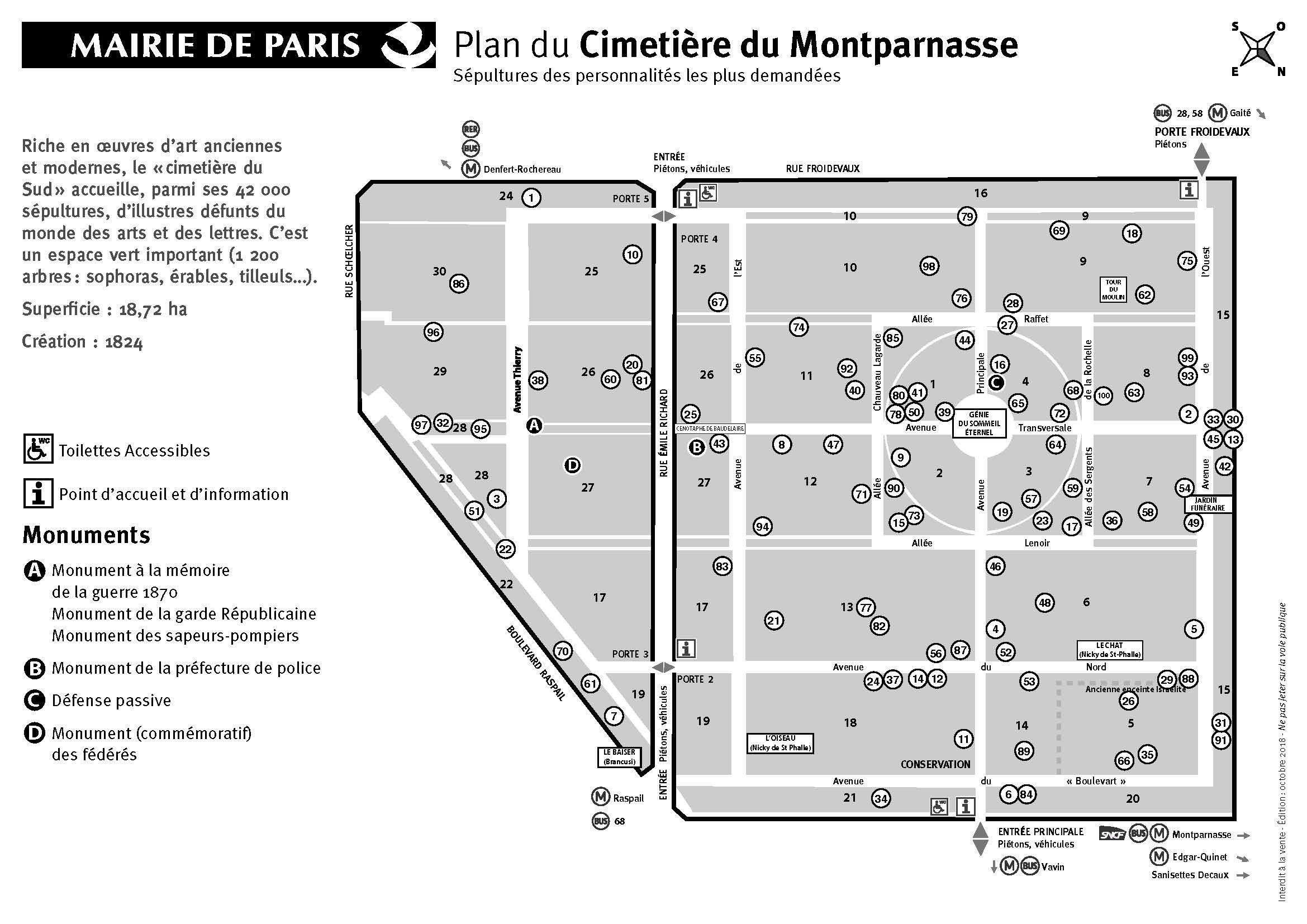
Map of Cimetière du Montparnasse in Paris, France

Grave Location:

Division 22

Grave Location Description

As you enter the cemetery from Gate 3 (at the intersection of Blvd Edgar Quinet and Blvd Raspail) walk straight ahead Rue Emile Richard and turn left onto Avenue Thierry. Follow this path around to the right and look to your left for the perhaps the grandest of all family monuments in Paris – the final resting place of Charles Pigeon.

Grave Location GPS

48.838227112286255, 2.3302259220006407

Visiting The Grave:

Photos:

[+]
[+]
[+]
[+]
[+]
[+]
[+]
[+]
[+]

FAQ's

Charles Pigeon was born on March 29, 1838.

Charles Pigeon was born in Le Mesnil-Lieubray, Normandy, France.

Charles Pigeon died on March 18, 1915.

Charles Pigeon died in 54 Rue de Rennes, Paris, France.

Charles Pigeon was 76.

The cause of death was Natural causes.

Charles Pigeon's grave is in Cimetière du Montparnasse

Read More About Charles Pigeon:

Videos Featuring Charles Pigeon:

See More:

Camille Flammarion

popular name: Camille Flammarion

date_of_death: June 3, 1925

age: 83

cause_of_death: Natural causes

claim_to_fame: Science

best_know_for: Camille Flammarion was a famous French astronomer, author, magazine publisher and notable psychical researcher. He was a prolific author of more than fifty titles, including popular science works about astronomy, several notable early science fiction novels, and works on psychical research and related topics. He also published the magazine L'Astronomie, starting in 1882. He maintained a private observatory at his home in Juvisy-sur-Orge, France which is open to the public today.

Jean Baptiste Perrin

popular name: Jean Baptiste Perrin

date_of_death: April 17, 1942

age: 71

cause_of_death: Natural Causes

claim_to_fame: Science

best_know_for: Jean Baptiste Perrin was a French physicist who, in his studies of the Brownian motion of minute particles suspended in liquids, verified Albert Einstein’s explanation of this phenomenon and thereby confirmed the atomic nature of matter (sedimentation equilibrium). He was awarded with the Nobel Prize for Physics in 1926 for this achievement.

Kurt Gödel

popular name: Kurt Gödel

date_of_death: January 14, 1978

age: 71

cause_of_death: Malnutrition and inanition caused by personality disturbance

claim_to_fame: Science

best_know_for: Kurt Gödel was a prominent Austrian/American logician, mathematician and philosopher who is mentioned as most likely autistic (Asperger's Syndrome) in Genius Genes by Michael Fitzgerald and Brendan O’Brien, in Asperger Syndrome – A Gift or a Curse? by Michael Fitzgerald and Viktoria Lyons. He is known in particular for Gödel's incompleteness theorems, Gödel's completeness theorem, the consistency of the Continuum hypothesis with ZFC, Gödel metric, Gödel's ontological proof and Gödel–Dummett logic, Among notable awards he has won are the Albert Einstein Award (1951), the National Medal of Science (1974) and ForMemRS (1968). He was also a Fellow of the British Academy. Looking back over that century in the year 2000, TIME magazine included Kurt Gödel (1906–78), the foremost mathematical logician of the twentieth century among its top 100 most influential thinkers. Gödel was associated with the Princeton University Institute for Advanced Study from his first visit in the academic year 1933–34, until his death in 1978. He was Professor in the School of Mathematics from 1953 until 1976, when he became Professor Emeritus.

Back to Top