Oliver Belmont

Birth Name:
Oliver Hazard Perry Belmont
Birth Date:
November 12, 1858
Birth Place:
New York City, New York
Death Date:
June 10, 1908
Place of Death:
Brookholt Estate, East Meadow, New York
Age:
49
Cause of Death:
Appendicitis
Cemetery Name:
Woodlawn Cemetery
Claim to Fame:
Business and Finance
Oliver Belmont was an American socialite and United States Representative from New York. Belmont was a member of the banking firm of August Belmont and Co., New York City. He became publisher of the Verdict, a weekly paper. Oliver was husband to the prominent multi-millionaire American socialite and a major figure in the American women's suffrage movement, Alva Vanderbilt Belmont.

Fun Fact

Yes, the Belmont Stakes are named after August Belmont, a financier who made quite a name and fortune for himself in New York politics and society. Obviously, Mr. Belmont was also quite involved in horse racing, and his imprint is even intertwined within the history of the Kentucky Derby. However, the one thing the Belmont does have over the Derby is that it is the oldest of the three Triple Crown events. The Belmont predates the Preakness by six years, the Kentucky Derby by eight. The first running of the Belmont Stakes was in 1867 at Jerome Park, on, believe it or not, a Thursday. At a mile and five furlongs, the conditions included an entry fee of $200, half forfeit with $1,500 added. Furthermore, not only is the Belmont the oldest Triple Crown race, but it is the fourth oldest race overall in North America.

Cemetery Information:

Final Resting Place:

Woodlawn Cemetery

4199 Webster Avenue

Bronx, New York, 10470

USA

North America

Map:
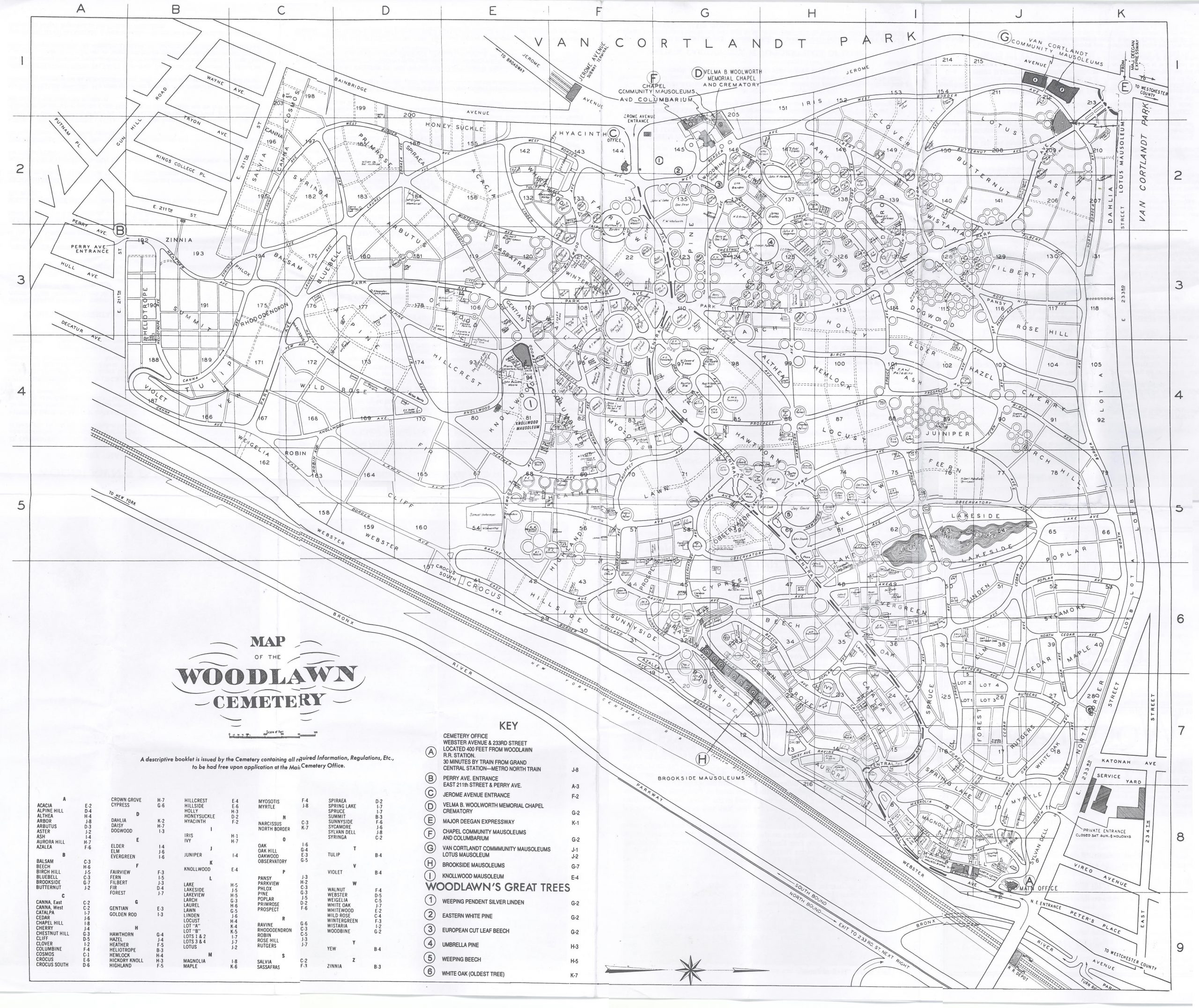
Map of Woodlawn Cemetery in the Bronx, New York City

Grave Location:

Whitewood Plot, Section 134

Grave Location Description

From the Jerome Avenue entrance turn right on West Border Avenue until you reach the first intersection. Look to your left and you will see the large, chapel-like structure which is actually the mausoleum of Alva and her husband Oliver.

Grave Location GPS

40.886798, -73.876808

Visiting The Grave:

Photos:

[+]
[+]
[+]
[+]
[+]
[+]
[+]
[+]
[+]
[+]
[+]
[+]
[+]
[+]
[+]
[+]
[+]
[+]

FAQ's

Oliver Belmont was born on November 12, 1858.

Oliver Belmont was born in New York City, New York.

Oliver Belmont died on June 10, 1908.

Oliver Belmont died in Brookholt Estate, East Meadow, New York.

Oliver Belmont was 49.

The cause of death was Appendicitis.

Oliver Belmont's grave is in Woodlawn Cemetery

Read More About Oliver Belmont:

Videos Featuring Oliver Belmont:
See More:

Cornelius Vanderbilt

popular name: Cornelius Vanderbilt

date_of_death: January 4, 1877

age: 82

cause_of_death: Exhaustion and chronic health issues

claim_to_fame: Business and Finance

best_know_for: The Vanderbilt name is synonymous with America’s Gilded Age. Upon their deaths, “Commodore” Cornelius Vanderbilt, who established the family’s fortune, and his son William H., who doubled it in just a few years, were the wealthiest men in the United States, if not the world. The steamboat and railroad companies they founded and led played a major role in the development of New York City and State. When he died in 1877 in his mansion at 10 Washington Place, Vanderbilt left a fortune of $105 million. He willed the bulk of it—$95 million, more than was possessed by the United States Treasury—to his oldest son, William Henry Vanderbilt.

Walter Knott

popular name: Walter Knott

date_of_death: December 3, 1981

age: 91

cause_of_death: Parkinson's disease

claim_to_fame: Business and Finance

best_know_for: Walter Knott was an American farmer who created the Knott's Berry Farm amusement park in California. In the 1920s, Walter Knott was a somewhat unsuccessful farmer, whose fortunes changed when he nursed several abandoned berry plants back to health. The hybrid boysenberry, named after its creator, Rudolph Boysen, was a cross between a blackberry, red raspberry and loganberry. The huge berries were a hit, and the Knott family sold berries, preserves and pies from a Buena Park, California roadside stand. In 1934, Knott's wife Cordelia (née Hornaday, January 23, 1890 – April 12, 1974) began serving fried chicken dinners, and within a few years, lines outside the restaurant were often several hours long. To entertain the waiting crowds, Walter built a Ghost Town in 1940, using buildings relocated from Old West towns. Even after Disneyland opened in 1955 a mere 8 miles away, Knott's Berry Farm continued to thrive. Walt Disney and Walter Knott are rumored to have had a cordial relationship; it is known that they each visited the other's park, and they were both members of the original planning council for Children's Hospital of Orange County. Early additions to the farm included a narrow gauge railroad, a San Francisco cable car, a Pan-for-Gold attraction, the Calico Mine Train dark ride and a log flume ride. In 1968, the Knott family fenced the farm, charged admission for the first time, and Knott's Berry Farm officially became an amusement park. Because of his interest in American pioneer history, Knott purchased and restored the real silver mining ghost town of Calico, California in 1951. As a child Walter spent a lot of time in Calico living with his uncle. During World War I he helped to build a silver mill in Calico. This period in his life influenced his decision to buy the town and restore it. In 1966, he deeded Calico to San Bernardino County, California. Walter remained active in the operation of Knott's Berry Farm until the death of Cordelia in 1974, leaving day-to-day park operations to his children.

John D. Rockefeller Sr.

popular name: John D. Rockefeller Sr.

date_of_death: May 23, 1937

age: 97

cause_of_death: Arteriosclerosis

claim_to_fame: Business and Finance

best_know_for: There’s rich, there’s wealthy, and then there’s John D. Rockefeller. Considered by many to be the most financially-prosperous individual in modern history with an estimated $900,000,000 bank balance (unadjusted for inflation) in the early 1910s, Rockefeller made his massive fortune by dominating the oil industry. While Rockefeller was prone to controversy—he was accused of being a monopoly in the fuel business—he was also a generous philanthropist, donating over a half-billion dollars in his lifetime (and that's also unadjusted for inflation).

Back to Top